
Tesla Solar Roof is reportedly being discontinued as the company moves away from its solar shingles and focuses more heavily on conventional solar panels. According to reporting from Electrek and The Verge, Tesla has stopped allowing its third-party installation partners to order the Solar Roof, potentially bringing an end to one of the company’s most ambitious renewable energy products.
The Tesla Solar Roof was designed to combine solar power generation with traditional-looking roof tiles. Rather than placing conventional solar panels on top of a roof, Tesla’s approach integrated photovoltaic technology directly into the roofing material.
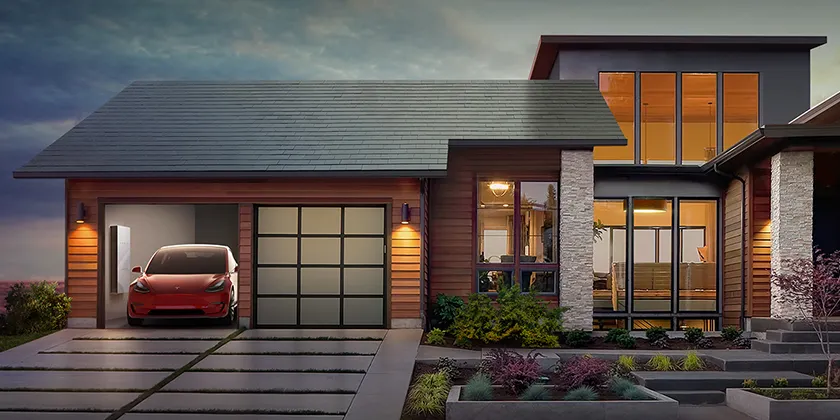
Source: Solar— Tesla Solar Roof
Tesla Solar Roof Is Reportedly No Longer Available to Order
According to Electrek, sources familiar with the Solar Roof program say Tesla has informed its third-party installer network that new Solar Roof orders are no longer available.
The company is reportedly expected to focus exclusively on its conventional solar panels for future installations.
Tesla has not publicly confirmed that it is discontinuing the Solar Roof. However, several changes to the company’s website appear to support the reports.
Tesla’s dedicated Solar Roof webpage now redirects visitors to its conventional solar panel page. The Solar Roof option has also disappeared from the navigation section for Tesla Energy products.
Tesla’s current energy lineup prominently features products such as Solar Panels, Powerwall, and Megapack.
A Product That Never Reached Tesla’s Original Ambitions
Tesla unveiled the Solar Roof in 2016, presenting it as a major step toward making solar energy more attractive to homeowners.
The concept was ambitious. Solar shingles could potentially provide renewable energy without giving a home the appearance of having traditional solar panels installed on its roof.
Mass production eventually began in 2020, but the product faced significant challenges.
Tesla CEO Elon Musk acknowledged in 2021 that the company had made major mistakes with the Solar Roof. Those problems contributed to higher costs, delays, and difficulties scaling installations.
The product also struggled to reach Tesla’s ambitious deployment targets.
Tesla’s move also highlights how smart home gadgets and connected home technology are increasingly becoming part of modern energy management.
A Wood Mackenzie report published in 2023 estimated that only around 3,000 US homes had received Solar Roof installations since its launch. That figure was far below Tesla’s earlier target of roughly 1,000 installations per week.
Why Tesla May Be Moving Away From Solar Roof
The reported decision appears to come down largely to economics.
Solar shingles are considerably more complex than conventional solar panels because they combine roofing materials with solar technology. Installation can also require more specialized work than mounting standard panels onto an existing roof.
According to Electrek’s reporting, Tesla has concluded that the Solar Roof is not financially viable for the company.
That would represent a significant shift from Tesla’s original vision for the product.
Instead of continuing to invest heavily in a complicated roofing system, Tesla appears to be concentrating its efforts on conventional solar panels, which can be produced and installed using a more established process.
Tesla Is Still Investing in Solar Energy
The reported end of Solar Roof does not mean Tesla is abandoning solar power.
The company continues to sell conventional solar panels and is reportedly planning a major expansion of its solar manufacturing capabilities.
Tesla is planning a new solar panel factory near Houston, Texas, with an estimated investment of around $10 billion. The facility is intended to significantly increase the company’s solar panel production capacity.
This suggests Tesla’s broader strategy may be shifting toward technologies that can be manufactured and deployed more efficiently rather than abandoning renewable energy altogether.
The Solar Roof’s Legacy
Tesla’s Solar Roof was one of the company’s more ambitious attempts to combine clean energy with consumer-friendly design.
The idea was appealing: homeowners could generate electricity from their roofs without covering them with conventional solar panels.
In practice, however, the product faced production challenges, installation difficulties, delays, and financial pressure.
If the reported discontinuation is confirmed, the Solar Roof could ultimately become an example of a technology that was impressive in concept but difficult to make commercially successful at scale.
For Tesla, the focus now appears to be shifting toward conventional solar panels and large-scale energy products such as Powerwall and Megapack.
Tesla has not yet publicly confirmed that the Solar Roof has been permanently discontinued, so the company’s official position will be important to watch as the situation develops.
Source: The Verge, reporting based in part on information from Electrek and Tesla’s public website.
Future Tech Hub will continue to follow developments in Tesla’s energy business and the broader renewable energy industry.