
Encryption vs decryption is a fundamental concept in cybersecurity, but the difference between the two is often misunderstood. Every time you send a message, sign in to an online account, make a payment, or visit a secure website, encryption may be working behind the scenes to protect your information.
Encryption and decryption are closely connected, but they perform opposite operations. Encryption transforms readable information into a protected format, while decryption converts that protected information back into a readable form for an authorized user or system.
Understanding how these two processes work makes it easier to understand the technology protecting passwords, online banking, messaging apps, cloud services, and secure websites.
Decryption is the process of turning protected information back into a readable form for an authorized recipient.
Although the two terms are closely connected, they describe opposite operations. Understanding the difference between encryption and decryption makes it easier to understand how passwords, online banking, messaging apps, cloud services, and secure websites protect information.
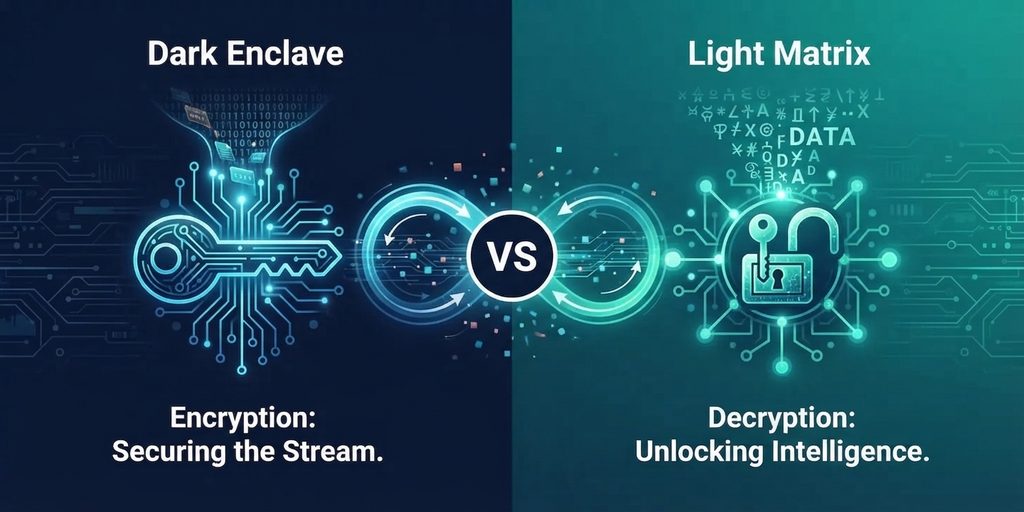
What Is Encryption?
Encryption is the process of converting readable information, known as plaintext, into an encoded form called ciphertext.
Understanding encryption vs decryption starts with recognizing what happens to information before it reaches its intended recipient. Encryption protects readable information by transforming it into ciphertext that cannot be easily understood without the appropriate key.
The purpose is to make the original information unreadable to anyone who does not have the necessary authorization or cryptographic key.
For example, imagine sending a message that says:
“Meet me at 7 PM.”
After encryption, the message could look like a completely meaningless sequence of characters.
The encrypted version is designed to be unreadable without the appropriate method and key needed to recover the original information.
Modern encryption does not simply hide information. Strong cryptographic algorithms are designed so that attempting to recover the original data without the required key is computationally impractical.
What Is Decryption?
Decryption reverses the encryption process.
When an authorized recipient receives encrypted information, a cryptographic system uses the appropriate key to convert the ciphertext back into readable plaintext.
In simple terms:
Plaintext → Encryption → Ciphertext → Decryption → Plaintext
The person receiving the information does not normally need to see the complicated mathematical operations taking place behind the scenes. Software handles the process automatically.
For example, when you visit a secure website, encryption helps protect information traveling between your browser and the website. Your browser and the server use cryptographic protocols to establish a secure connection and protect the data being exchanged.
Encryption vs. Decryption: The Key Difference
The simplest way to understand the difference is to think about their direction.
| Encryption | Decryption |
|---|---|
| Converts readable data into protected data | Converts protected data back into readable data |
| Protects information from unauthorized access | Allows authorized users or systems to access the original information |
| Produces ciphertext | Produces plaintext |
| Happens before protected data is transmitted or stored | Happens when protected data needs to be accessed |
| Uses cryptographic keys | Uses the appropriate cryptographic key or keys |
Encryption protects the information.
The easiest way to understand encryption vs decryption is to look at the direction in which information moves. Encryption protects readable data, while decryption restores that protected information for an authorized user or system.
Decryption makes that protected information usable again.
Both processes are essential to many secure communication systems.
How Does Encryption Actually Work?
Modern encryption relies on mathematics, algorithms, and cryptographic keys.
A cryptographic key is information used by an encryption algorithm to transform data. Depending on the type of encryption, the same key or a different key may be required for decryption.
The strength of an encryption system depends on several factors, including the algorithm, key management, implementation, and key length.
A strong encryption algorithm should make it extremely difficult for an attacker to recover the original information without the required key.
This is why simply knowing that encryption is being used is not enough to determine whether a system is secure. Poor implementation or badly protected keys can undermine otherwise strong cryptography.
Symmetric Encryption Uses One Key
One major category is symmetric encryption.
With symmetric encryption, the same secret key is generally used to encrypt and decrypt the data.
The basic process looks like this:
Secret key + plaintext → encryption → ciphertext
Then:
Ciphertext + secret key → decryption → plaintext
Symmetric encryption is generally fast and efficient, making it useful for protecting large amounts of data.
It is commonly used for things such as stored files, databases, disk encryption, and encrypted network communications.
The major challenge is key distribution.
If two parties need to communicate securely using the same secret key, they need a secure way to obtain and protect that key.

Asymmetric Encryption Uses Two Keys
Asymmetric encryption, also known as public-key cryptography, works differently.
It uses a pair of mathematically related keys:
- Public key
- Private key
The public key can generally be shared openly, while the private key must remain secret.
For encryption, someone can use a recipient’s public key to protect information. The corresponding private key can then be used to decrypt it.
This solves some of the key-distribution problems associated with symmetric encryption.
Public-key cryptography is also important for digital signatures and secure communications.
Modern security systems frequently combine asymmetric and symmetric cryptography rather than relying exclusively on one approach.
Encryption Is Everywhere Online
You interact with encryption far more often than you might realize.
Websites
When you see HTTPS in your browser, cryptographic protocols are being used to help protect communication between your device and the website.
This is particularly important when transmitting sensitive information such as login credentials or payment information.
Messaging Apps
Many modern messaging services use encryption to protect conversations.
Some services use end-to-end encryption, which is designed so that only the communicating users can access the message contents.
The exact security model varies between services, so encryption does not automatically mean every aspect of a messaging platform is hidden.
Online Banking
Financial institutions rely heavily on cryptography to protect communications, transactions, authentication systems, and sensitive information.
Without strong cryptographic protections, transmitting financial information over networks would be significantly more dangerous.
Cloud Storage
Encryption can also protect files stored in cloud services.
Data may be encrypted while it is being transferred and while it is stored. These are commonly described as encryption in transit and encryption at rest.
Encryption Does Not Mean a System Is Automatically Secure
This is an important distinction.
Encryption is powerful, but it is not a complete cybersecurity solution.
A system can use strong encryption and still be vulnerable because of stolen passwords, malware, phishing, insecure software, poor access controls, or compromised devices.
For example, if an attacker gains access to an account that is legitimately authorized to view encrypted information, the encryption itself may not stop that attacker from accessing the data.
This is why encryption works alongside other security measures such as authentication, access controls, software updates, and multi-factor authentication.
Using two-factor authentication can provide another layer of protection when someone attempts to access an account.
Encryption and Hashing Are Not the Same
Encryption is sometimes confused with hashing, but they serve different purposes.
Encryption is designed to be reversible when the appropriate key is available.
Hashing is generally designed to be a one-way transformation.
A hash function takes data and produces a fixed-length output called a hash. The original information is not normally recovered by simply reversing the hash.
Hashing is widely used for password storage, data integrity checks, and other security applications.
This distinction is important because a password should generally not be stored as plain text or simply encrypted in a way that allows easy recovery. Secure password systems use specialized password-hashing techniques designed to make large-scale guessing attacks more difficult.
What Happens If an Encryption Key Is Stolen?
An encryption system is only as strong as its overall implementation and key management.
If an attacker obtains a secret cryptographic key, they may be able to decrypt information protected by that key, depending on how the system is designed.
That is why organizations treat cryptographic keys as sensitive assets.
Keys may need to be securely generated, stored, rotated, revoked, and protected against unauthorized access.
In large organizations, key management can become just as important as selecting a strong encryption algorithm.
Can Encryption Be Broken?
No encryption system should be described as completely impossible to break.
In practice, the goal of modern cryptography is to make unauthorized decryption computationally infeasible with currently available technology and reasonable resources.
Attackers may attempt to obtain the key, exploit weaknesses in the implementation, steal credentials, compromise an endpoint, or use other methods rather than directly breaking the underlying mathematical algorithm.
This is why cybersecurity professionals often focus on the entire system rather than treating encryption as a single defensive barrier.
Why Encryption Matters for Cybersecurity
The importance of encryption continues to grow as more personal, financial, business, and government information moves through digital systems.
Without encryption, sensitive information could be exposed while traveling across networks or sitting on devices and servers.
Encryption helps protect confidentiality, one of the fundamental goals of information security.
It can also contribute to data integrity and authentication when combined with other cryptographic mechanisms.
As organizations move more workloads into cloud environments and increasingly rely on connected devices and digital services, protecting information throughout its lifecycle becomes even more important.
The Bottom Line
Encryption and decryption are two sides of the same fundamental security process.
Encryption transforms readable information into protected ciphertext, while decryption converts that ciphertext back into readable information for an authorized user or system.
The technology behind these processes can be highly sophisticated, but the basic concept is straightforward: encryption protects information, and decryption makes that protected information accessible again.
From secure websites and messaging applications to banking systems, cloud storage, and enterprise networks, cryptography is quietly working behind the scenes every day.
Understanding the difference between encryption and decryption is therefore more than learning two technical terms. It is a basic step toward understanding how modern digital security protects information in an increasingly connected world.
For a deeper look at how modern cryptography is used to protect sensitive information, the National Institute of Standards and Technology (NIST) provides detailed guidance and resources covering encryption, cryptographic standards, and data security.
Stay Ahead With Future Tech Hub
Technology moves fast. We keep you ahead with the latest AI, technology, cybersecurity, software, and gadget news.