
The AI industry spent years chasing one simple idea: build bigger models, add more computing power, and make artificial intelligence smarter.
That strategy helped produce some of the biggest breakthroughs in generative AI. Larger models became better at writing, coding, reasoning, understanding images, and handling increasingly complex tasks.
But the next phase of artificial intelligence is beginning to look very different.
The competition is no longer only about who can build the largest model. Companies are increasingly focused on making AI faster, cheaper, more efficient, more capable, and more useful in the real world.
That shift could reshape the entire AI industry.
Bigger Models Are Becoming More Expensive
Training increasingly powerful AI models requires enormous amounts of computing power, specialized chips, electricity, data, and engineering talent.
The cost does not stop after a model is trained.
Every time millions of people use an AI system, companies have to spend money running the infrastructure required to generate responses. As AI becomes integrated into search engines, productivity software, coding tools, customer service, and business applications, inference costs can become a major part of the equation.
That creates a problem for AI companies.
A model that is slightly more capable but dramatically more expensive to operate may not always be the best commercial product.
The industry is therefore paying much more attention to efficiency.
Instead of simply asking how large a model can become, researchers and companies are asking how much intelligence they can deliver with less computing power.
AI Reasoning Is Becoming More Important
One of the biggest changes in modern AI is the growing focus on reasoning.
Early generative AI systems were primarily designed to predict and generate text. Newer systems are increasingly being developed to spend more computational effort working through difficult problems before producing an answer.
This approach can make AI more useful for programming, mathematics, research, planning, and other complicated tasks.
The important point is that progress does not necessarily require dramatically increasing the size of the underlying model.
Better training techniques, improved reasoning methods, specialized architectures, and smarter use of computing resources can also produce significant improvements.
That is changing the way companies think about AI development.
AI Agents Could Be the Next Major Battleground
The biggest opportunity may not be another chatbot.
It could be AI agents.
Unlike traditional chatbots that primarily respond to questions, AI agents are designed to perform tasks. Depending on the system, an agent can interact with software, use tools, retrieve information, write code, analyze data, and complete multiple steps toward a goal.
This creates an entirely different vision for AI.
Instead of asking an AI assistant to explain how to perform a task, a user could eventually tell it what outcome they want and allow the system to handle much of the process.
For example, an AI agent could research a business problem, analyze a company’s data, prepare a report, and organize the results with limited human intervention.
That makes the AI agent market potentially much larger than the traditional chatbot market.
The technology is still developing, and reliability remains a major challenge. But if agents become dependable enough for important business tasks, they could fundamentally change how people interact with software.
Smaller AI Models Are Getting More Interesting
Another major shift is happening at the opposite end of the scale.
Instead of building only enormous models that require massive data centers, companies are also developing smaller and more efficient models.
Smaller AI systems can be useful because they may require less computing power and can potentially run on local devices.
That matters for smartphones, PCs, industrial equipment, vehicles, and other connected devices.
Local AI can also offer advantages around privacy and latency because some tasks can be processed directly on the device rather than sending every request to a remote data center.
This does not mean large models are becoming irrelevant.
Instead, the future may involve different AI models for different jobs.
A powerful cloud-based model might handle a complex research task, while a smaller model handles everyday functions directly on a phone or computer.
AI Chips Are Becoming a Critical Advantage
The AI race is also increasingly becoming a semiconductor race.
Modern AI systems depend heavily on specialized processors capable of performing enormous numbers of calculations efficiently.
Graphics processing units and other AI accelerators have become critical infrastructure for training and running advanced models.
But hardware development is also changing.
Companies are looking for ways to improve performance while reducing energy consumption and operating costs. Specialized chips designed for particular AI workloads could become increasingly important as demand for computing continues to grow.
This means the companies shaping the future of AI may not all be model developers.
Chip designers, semiconductor manufacturers, cloud providers, and infrastructure companies could play just as important a role.
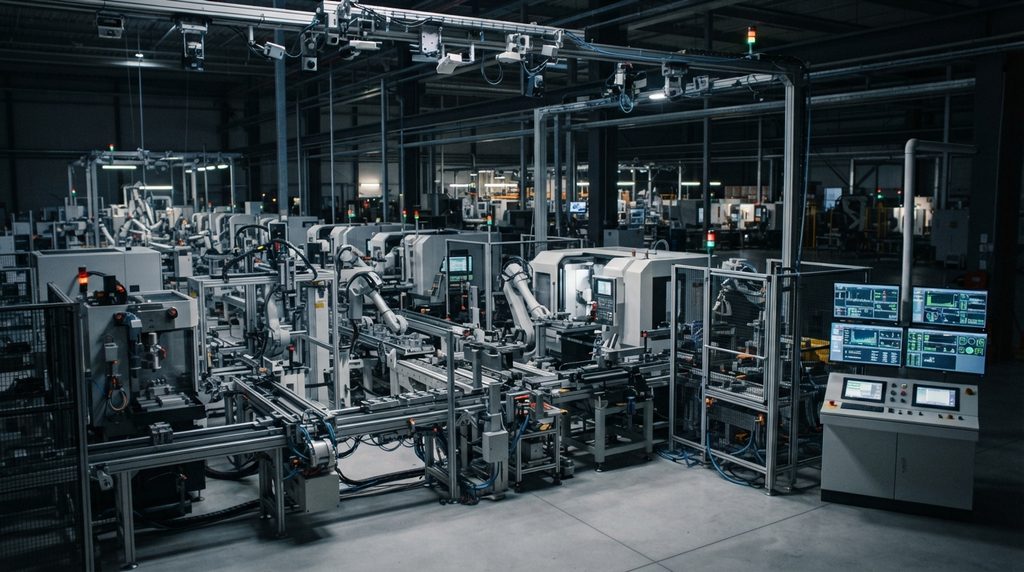
AI Is Moving Into the Real World
For years, much of the AI revolution happened inside computers.
That is changing.
AI is increasingly being connected to cameras, sensors, industrial systems, vehicles, medical equipment, and other physical technologies.
This is sometimes described as physical AI.
The goal is to allow AI systems to understand and respond to information from the physical world rather than simply processing text and images on a screen.
That creates opportunities in manufacturing, logistics, healthcare, transportation, agriculture, and other industries.
The challenge is significantly greater than building a chatbot.
Real-world systems have to deal with unpredictable environments, safety requirements, hardware limitations, and extremely high reliability standards.
But if these challenges can be solved, physical AI could become one of the most important areas of technological development over the next decade.
Data and Infrastructure Matter More Than Ever
Better AI is not created by models alone.
Models depend on enormous amounts of high-quality data and infrastructure.
Companies need data centers, networking equipment, storage, energy, specialized processors, cooling systems, and software infrastructure to build and operate advanced AI systems.
Data quality is also becoming increasingly important.
Having enormous quantities of information does not automatically produce a better AI system. High-quality, diverse, relevant, and properly prepared data can be much more valuable than simply collecting more of it.
This is creating opportunities for companies that specialize in data preparation, AI infrastructure, security, monitoring, and deployment.
The AI economy is therefore becoming much broader than the companies developing the models themselves.
AI Safety Is Becoming Part of the Competition
As AI systems become more capable, safety is becoming increasingly important.
More capable models can potentially perform more useful tasks, but they can also create new security and reliability risks.
AI systems may generate incorrect information, expose sensitive data, assist malicious actors, or behave unpredictably when given complex tasks.
That makes testing, monitoring, cybersecurity, and responsible deployment increasingly important.
The companies that build the most capable AI may not necessarily be the ones that succeed.
Companies that can make advanced AI reliable and safe enough for businesses to trust could have a major competitive advantage.
The AI Industry Is Becoming More Diverse
The first stage of the generative AI boom created enormous attention around a relatively small group of companies building foundation models.
The next stage could be much more distributed.
There will still be competition between major AI laboratories, but thousands of other companies are building products and infrastructure around them.
Some are developing specialized models.
The rapid evolution of artificial intelligence can be seen across research, investment, computing power, and real-world adoption. The Stanford AI Index provides detailed data and analysis on these trends, offering a broader view of how quickly the AI industry is developing and where the technology may be heading.
Others are creating AI agents, developer tools, cybersecurity systems, data platforms, hardware, cloud infrastructure, and industry-specific applications.
This means the AI industry may eventually look less like a competition between a handful of companies and more like a massive technology ecosystem.
The New AI Competition Is About More Than Intelligence
The most important question for the next generation of AI may not be:
“Who has the biggest model?”
It may be:
“Who can turn AI into the most useful technology?”
That requires much more than model size.
Companies need efficient infrastructure, better reasoning, reliable agents, specialized hardware, high-quality data, strong security, and products that solve real problems.
The winners could be companies that combine several of these advantages rather than simply producing the largest AI model.
What Comes Next for Artificial Intelligence?
The AI industry is entering a more complicated phase.
The early excitement surrounding generative AI was driven largely by increasingly capable models. But as the technology matures, the focus is expanding toward efficiency, reasoning, agents, hardware, infrastructure, physical AI, and practical applications.
That does not mean bigger models are finished.
Large models will likely continue improving, and enormous amounts of computing power will remain important.
But size alone is unlikely to define the next decade of AI.
The companies that ultimately shape the industry may be the ones that figure out how to make artificial intelligence more capable without making it unnecessarily expensive, more autonomous without sacrificing control, and more powerful without making it impossible to trust.
The next AI breakthrough may therefore not come from a model that is simply bigger.
It could come from a system that is smarter, faster, cheaper, and capable of actually getting things done.
Stay Ahead With Future Tech Hub
Technology moves fast. We keep you ahead with the latest AI, technology, cybersecurity, software, and gadget news.