
Artificial intelligence has moved beyond simply answering questions and generating text. A newer generation of AI systems can understand a goal, make decisions, use tools, and carry out multiple steps to complete a task. These systems are commonly known as AI agents.
AI agents are becoming an important part of the technology industry because they can do more than respond to a single prompt. Instead, they can work through a problem and take actions based on the information they receive.
But what exactly is an AI agent, how does it work, and how is it different from a traditional chatbot?
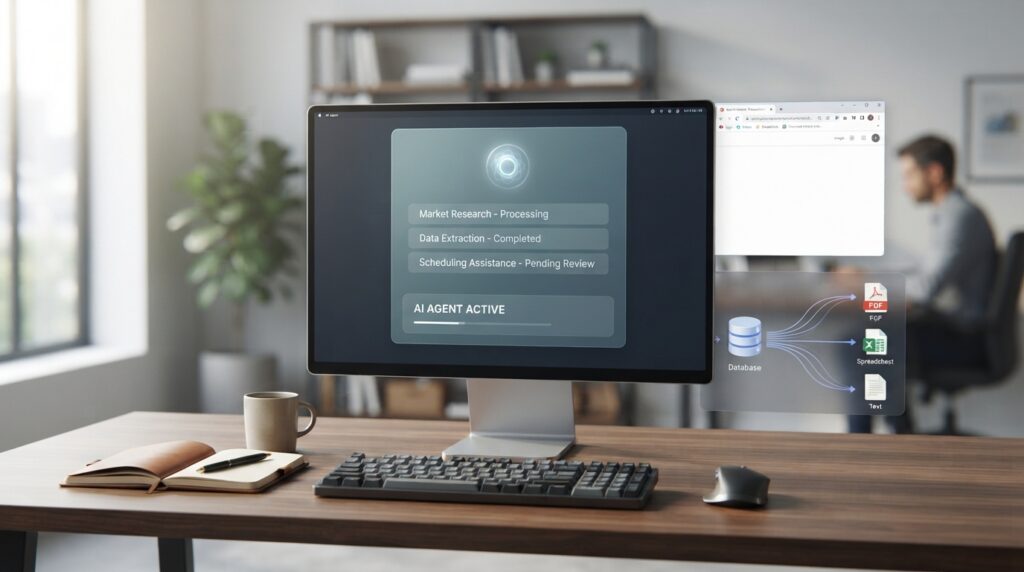
What Is an AI Agent?
An AI agent is a software system that uses artificial intelligence to pursue a goal by observing information, making decisions, and taking actions.
A traditional chatbot generally waits for a user to ask something and then generates a response. An AI agent can go further. Depending on how it is designed, it may be able to determine what needs to be done, break a task into smaller steps, use external tools, evaluate the results, and continue working until the goal is reached.
For example, imagine asking an AI system:
“Find three suitable laptops for video editing and compare their prices and specifications.”
A basic AI model might provide an answer based on information it already knows. An AI agent could potentially search websites, collect current specifications and prices, compare the products, organize the information, and present the results.
The important difference is action.
An AI agent is designed not only to generate information but also to interact with its environment and perform tasks.
How Do AI Agents Work?
Although AI agents can be built in many different ways, most involve several fundamental components.
Understanding the Goal
The first step is understanding what the user or another system wants to accomplish.
For example, a user might tell an agent to:
- Research a topic
- Analyze a document
- Schedule a meeting
- Monitor a system
- Find information online
- Write and organize a report
The agent needs to interpret the objective before deciding what actions to take.
Planning
More complicated tasks often need to be divided into smaller steps.
Suppose an AI agent is asked to create a market research report. Instead of attempting everything at once, it could determine that it needs to research the market, collect information about competitors, analyze the data, and then prepare the report.
This planning ability is one of the features that makes agents different from simple question-and-answer systems.
Using Tools
AI agents can be connected to external tools and services.
Depending on their design, an agent may be able to use:
- Web search
- Databases
- APIs
- Spreadsheets
- Software applications
- File systems
- Email services
- Business platforms
- Code execution environments
The AI model can decide when a particular tool is needed and use the result as part of the larger task.
For example, an agent working with a company’s inventory system could retrieve stock information from a database before making a recommendation.
Taking Actions
An AI agent can perform actions through the tools available to it.
For example, an agent could potentially create a document, update a database, send information to another application, or trigger an automated workflow.
The exact capabilities depend on the permissions and tools given to the agent.
This is important because an AI model itself does not automatically have access to every computer system or website. Developers have to connect the agent to the appropriate tools and determine what it is allowed to do.
Checking Results
Some AI agents can evaluate the results of their actions and determine whether another step is necessary.
For example, an agent searching for information might discover that its first search did not provide enough useful results. It could perform another search, refine its approach, and continue.
This creates a cycle that can look roughly like:
Understand → Plan → Act → Observe → Adjust → Complete
The exact architecture varies between AI agent systems, but this general process is common.
AI Agent vs. Chatbot: What’s the Difference?
AI chatbots and AI agents are closely related, but they are not necessarily the same thing.
A traditional chatbot is primarily designed to communicate with users. You ask a question, and it generates a response.
An AI agent is designed around achieving a goal.
For example, if you ask a chatbot:
“How do I reset my password?”
It can explain the steps.
An AI agent connected to the appropriate account-management system might be able to identify the account, start the password-reset process, and guide the user through any required verification.
AI agents are part of a broader shift toward more capable AI systems. How AI Assistants Are Changing the Way We Use Technology explains how AI assistants are already changing the way people interact with software and digital services.
The distinction is not always absolute. Modern AI assistants can combine conversational interfaces with agent-like capabilities. In practice, the difference often comes down to how much autonomy, tool access, and task execution the system has.

Why Are AI Agents Becoming Important?
One reason AI agents are attracting attention is their potential to automate tasks that previously required people to move information between different applications.
Consider a business employee who receives a customer request by email. Normally, the employee might need to read the message, look up the customer’s account, check an internal system, prepare a response, and update a record.
An AI agent could potentially coordinate several of these steps automatically.
This could make AI particularly useful for repetitive workflows.
Companies are exploring AI agents for areas such as:
- Customer support
- Software development
- IT operations
- Research
- Data analysis
- Marketing
- Sales
- Cybersecurity
- Business administration
The goal is not necessarily to replace every human task. In many cases, the goal is to allow people to spend less time on repetitive work and more time on tasks that require judgment and creativity.
AI Agents in Software Development
Software development is one area where AI agents are receiving significant attention.
A coding agent can potentially analyze an existing codebase, identify a problem, write or modify code, run tests, examine errors, and make additional changes.
This is different from simply asking an AI to generate a piece of code.
Instead, the agent can participate in a longer development workflow.
For developers, this could mean AI becomes less of a tool that simply generates snippets and more of a system capable of assisting with larger programming tasks.
However, human review remains important. AI-generated code can contain bugs, security vulnerabilities, incorrect assumptions, or changes that unintentionally affect other parts of an application.
AI Agents and Automation
AI agents can also work alongside automation platforms.
Traditional automation usually follows predefined rules.
For example:
If a new email arrives → save the attachment → add information to a spreadsheet.
An AI-powered workflow can introduce more flexibility.
An agent might read the email, understand its contents, decide which information is important, determine which application should receive the data, and then perform the required actions.
This does not mean traditional automation is becoming obsolete. Instead, AI can add a layer of decision-making to workflows that previously relied heavily on fixed rules.
What Are the Risks of AI Agents?
The ability to take actions also introduces additional risks.
A chatbot that generates an incorrect answer can be inconvenient. An AI agent with access to business systems could potentially cause a much bigger problem if it makes an incorrect decision.
Potential risks include:
- Incorrect actions
- Security vulnerabilities
- Unauthorized access
- Exposure of sensitive information
- Poor decision-making
- Prompt injection attacks
- Unintended changes to systems
- Excessive use of resources
For this reason, developers need to carefully control what an agent can access and what actions it is allowed to perform.
Permission controls, monitoring, testing, human approval, and security measures can all be important when deploying AI agents in real-world environments.
Do AI Agents Think Like Humans?
Despite the word “agent,” AI agents should not be confused with human intelligence.
An AI agent can analyze information, generate plans, and perform actions, but that does not mean it has human consciousness or understanding.
The system operates using AI models, software instructions, tools, data, and predefined permissions.
It can appear highly capable because it can combine these components to complete complex tasks. However, it can still make mistakes or misunderstand a situation.
Human oversight can therefore remain important, particularly when agents are given access to sensitive information or systems where mistakes could have serious consequences.
What Is the Future of AI Agents?
AI agents could become an increasingly common part of software and business applications.
Instead of opening separate applications and manually performing every step, users may increasingly describe what they want to accomplish and allow AI systems to coordinate the necessary actions.
For example, instead of manually collecting information from several applications, a user could ask an AI agent to gather the information, analyze it, and prepare a report.
This could lead to a shift in how people interact with software. Rather than learning exactly where every function is located, users may increasingly interact with applications through natural language.
However, the technology is still developing. Making AI agents reliable, secure, predictable, and capable of handling complex real-world situations remains a significant challenge.

Final Thoughts
AI agents represent an important evolution in artificial intelligence.
While traditional AI systems often focus on generating responses, AI agents can be designed to understand goals, plan tasks, use tools, take actions, and adapt based on results.
That makes them potentially useful for everything from everyday productivity to software development and business automation.
The technology is still developing, and AI agents are not capable of reliably handling every task without supervision. But as AI models, tools, and automation systems continue to improve, agents could become a much more common way of interacting with computers.
The next stage of AI may not simply be about asking a computer for an answer. It may be about telling it what you want accomplished and allowing it to help carry out the work.
Stay Ahead With Future Tech Hub
Technology moves fast. We keep you ahead with the latest AI, technology, cybersecurity, software, and gadget news.