
For years, the internet has followed a simple pattern: your device sends information somewhere far away, powerful servers process it, and the result comes back.
That model has worked remarkably well. Cloud computing has made it possible to store enormous amounts of data, run sophisticated applications, and access powerful services from almost anywhere.
But technology is creating a new problem.
There is simply too much data, too many connected devices, and too much demand for instant responses.
A self-driving vehicle cannot afford to wait for a distant data center to decide whether an obstacle is in its path. A factory machine detecting a dangerous fault may need to react immediately. An augmented reality application can feel broken if every movement has to travel across the internet before the system responds.
This is where edge computing comes in.
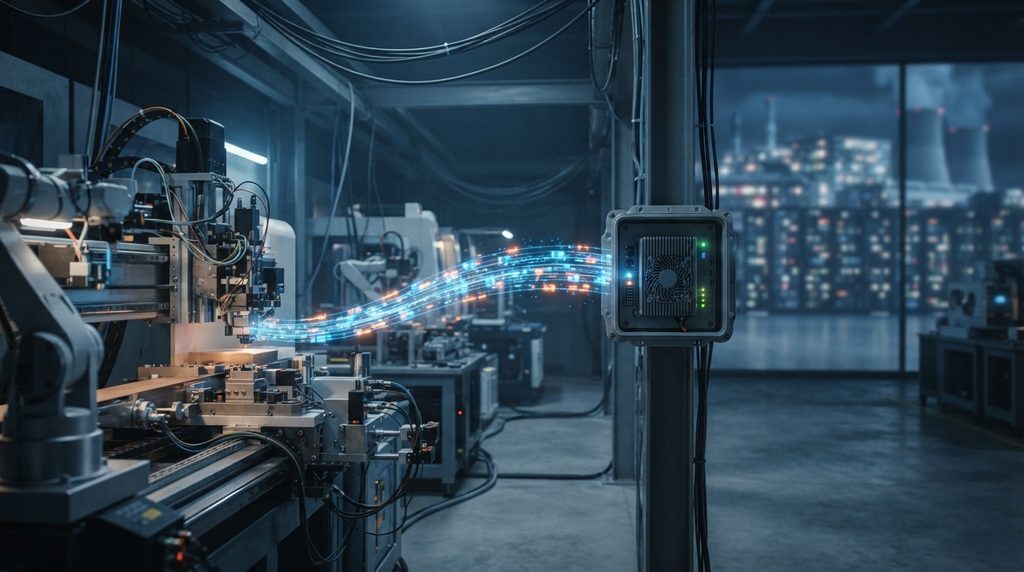
Instead of sending every piece of data to a distant cloud data center, edge computing moves computing and data processing closer to where the information is actually created.
The result can be faster responses, reduced network traffic, greater reliability, and new possibilities for applications that need to react almost instantly.
What Is Edge Computing?
Edge computing is a computing architecture that processes data closer to the devices, users, or systems generating that data instead of sending everything to a centralized cloud or data center.
The “edge” refers to the outer parts of a network—places closer to where data is produced and consumed.
That could be:
- A smart camera processing video locally
- A server inside a factory
- A telecommunications edge facility
- A retail store running local analytics
- A vehicle processing sensor information
- A local gateway connecting Internet of Things devices
- A nearby edge data center serving a specific geographic area
The basic idea is simple:
Move computing closer to the action.
Instead of:
Device → Internet → Distant cloud → Internet → Device
an edge architecture can look more like:
Device → Nearby edge system → Device
The cloud still has an important role, but it no longer has to handle every decision or every piece of raw data.
Why Does Edge Computing Matter?
The biggest reason is latency.
Latency is the amount of time it takes for data to travel between systems and for a response to come back.
For ordinary activities such as reading an article or sending an email, a small delay may not matter.
But some applications operate on a completely different timescale.
Imagine a security camera monitoring a restricted area. If every video frame has to travel hundreds or thousands of kilometers to a centralized data center before being analyzed, the system introduces unnecessary delay.
An edge device can analyze the footage locally and send only the relevant information elsewhere.
The same principle applies to industrial machinery, vehicles, healthcare equipment, gaming systems, and many AI applications.
When milliseconds matter, distance matters.
Edge Computing vs Cloud Computing
Edge computing does not mean the cloud is disappearing.
In reality, the two technologies are increasingly designed to work together.
Cloud computing is excellent for centralized tasks such as large-scale storage, training AI models, analyzing huge datasets, managing applications, and coordinating systems across many locations.
Edge computing is better suited to tasks that require rapid local processing.
Think of the cloud as the central brain for large-scale operations, while edge systems act more like local processing centers that can make decisions close to where data is generated.
A smart factory, for example, could use edge computers to monitor machinery in real time while sending selected data to the cloud for long-term analysis.
The cloud can identify trends across months of production.
The edge can react to a problem happening right now.
How Does Edge Computing Work?
An edge computing system typically involves several layers working together.
Data Is Generated
The process begins with devices producing information.
These could include cameras, sensors, smartphones, industrial machines, vehicles, medical devices, or other connected equipment.
Modern environments can generate enormous quantities of data.
A single high-resolution camera, for example, can continuously produce a large stream of video data.
Sending every bit of that raw information to the cloud can consume significant bandwidth.
Data Is Processed Nearby
Instead of sending everything immediately to a distant data center, an edge device or nearby server can process the information locally.
The system might filter, analyze, compress, or respond to the data.
Only the information that actually needs centralized processing may then be sent to the cloud.

Important Results Can Happen Locally
This is where edge computing becomes particularly powerful.
Suppose an industrial sensor detects that a machine is overheating.
An edge system could identify the problem immediately and trigger an emergency response.
The cloud could still receive the event and store it for future analysis, but the immediate decision does not have to wait for the cloud.
Edge Computing and the Internet of Things
The growth of the Internet of Things (IoT) is one of the major forces driving edge computing.
IoT devices are everywhere.
Factories use sensors to monitor equipment. Cities deploy connected infrastructure. Retailers track inventory. Hospitals use connected medical equipment. Buildings monitor energy consumption.
These devices can generate huge amounts of information.
If every sensor constantly sends raw data to a centralized cloud, networks can become inefficient and expensive.
Edge computing allows some of that information to be processed close to the source.
A smart factory, for example, might have thousands of sensors monitoring temperature, vibration, pressure, and machine performance.
Rather than sending every measurement to the cloud, an edge system can analyze the data locally and send only important events, summaries, or anomalies.
That can dramatically reduce unnecessary data movement.
Edge Computing and Artificial Intelligence
Edge computing is becoming especially important as artificial intelligence moves into more devices.
AI systems can require significant computing resources, but not every AI task needs to happen in a distant cloud.
Modern edge devices can perform certain AI inference tasks locally.
Consider a smart security camera.
Instead of constantly uploading video to the cloud, the camera or an nearby edge computer could analyze the footage and determine whether something important has happened.
The system might transmit only a short event or alert.
This approach can reduce bandwidth requirements while also improving response times.
The same concept is being explored in robotics, autonomous systems, healthcare, industrial automation, smartphones, and other environments where AI needs to operate close to the physical world.
Edge Computing in Autonomous Vehicles
Few technologies demonstrate the importance of low latency better than autonomous and connected vehicles.
A vehicle can collect information from cameras, radar, lidar, GPS, and other sensors.
Some of the resulting decisions need to happen immediately.
If a vehicle detects an obstacle directly ahead, it cannot depend on a distant cloud server to determine what to do next.
Local computing allows the vehicle to process critical sensor information and react rapidly.
Cloud systems can still play a major role by analyzing driving data, improving models, managing fleets, and supporting software development.
But the most time-sensitive decisions need to happen close to the vehicle itself.
Edge Computing in Smart Cities
Cities are also becoming increasingly connected.
Traffic systems, public transportation, environmental sensors, street lighting, security systems, and energy infrastructure can all generate data.
Edge computing can allow cities to process some of that information locally.
A traffic management system could analyze congestion near an intersection and adjust signals without waiting for information to travel to a distant data center.
Environmental sensors could identify unusual pollution levels and report them immediately.
Connected infrastructure can become more responsive when processing happens close to where events occur.

Edge Computing in Healthcare
Healthcare is another area where fast and reliable processing can be valuable.
Connected medical devices can generate continuous streams of information.
Edge systems could process certain measurements locally, allowing healthcare equipment to respond quickly or alert staff when something requires attention.
There is also a privacy advantage in some scenarios.
If sensitive information can be processed locally instead of constantly being transmitted to centralized infrastructure, organizations may be able to reduce the amount of personal data traveling across networks.
That does not automatically make an edge system secure or private, but it can change how data is handled.
Edge Computing and Gaming
Gaming is another industry where latency can directly affect the user experience.
Cloud gaming relies heavily on remote servers to render games and stream the results to players.
The farther the player is from the computing infrastructure, the more challenging latency can become.
Edge computing can place computing resources closer to players, potentially reducing the distance data has to travel.
This can be especially important for fast-paced multiplayer games, virtual reality, and augmented reality applications.
For immersive applications, even small delays can make interactions feel less natural.
What Are the Benefits of Edge Computing?
Edge computing offers several important advantages.
Lower Latency
Processing data closer to the user or device can reduce the time required for information to travel back and forth.
This is one of the most important benefits for real-time applications.
Reduced Bandwidth Usage
Instead of sending every piece of raw data to the cloud, edge systems can filter and process information locally.
Only useful or relevant data needs to travel further.
Greater Reliability
Some edge applications can continue operating even when the connection to a centralized cloud service is slow or temporarily unavailable.
A local industrial system, for example, may still be able to perform critical functions without relying entirely on an external connection.
Faster Decision-Making
Local processing allows systems to respond to events without waiting for a distant server.
This is particularly important for automation, robotics, vehicles, and other time-sensitive applications.
Potential Privacy Benefits
Processing sensitive information locally can reduce the amount of data that needs to leave a particular environment.
However, privacy still depends on how the entire system is designed and managed.
What Are the Challenges of Edge Computing?
Edge computing isn’t a perfect solution.
Moving computing closer to users creates its own challenges.
More Devices to Secure
A centralized data center is relatively concentrated.
An edge environment can involve hundreds or thousands of distributed devices and servers.
Every additional system can become another potential target for attackers.
Organizations therefore need strong authentication, access controls, encryption, monitoring, and patch management.
Managing Distributed Infrastructure
Maintaining one central data center is different from maintaining computing infrastructure spread across factories, stores, vehicles, cell towers, and remote locations.
Hardware failures, software updates, connectivity problems, and physical security all become more complicated.
Limited Computing Resources
An edge device may not have the same processing power or storage capacity as a large cloud data center.
Developers have to decide carefully which tasks should happen locally and which should be sent to centralized infrastructure.
Higher Operational Complexity
Edge computing often adds another layer to an organization’s technology environment.
Companies need to manage the relationship between devices, edge systems, networks, and cloud services.
That complexity can increase costs and require specialized skills.
Is Edge Computing Replacing the Cloud?
No.
The future is much more likely to involve edge computing and cloud computing working together.
Some tasks are naturally suited to centralized infrastructure.
Others need to happen close to the user or device.
A modern application may therefore use both.
For example:
Edge: Process sensor data and make immediate decisions.
Cloud: Store large datasets, perform long-term analysis, train AI models, and manage the wider system.
This hybrid approach allows organizations to use the strengths of both architectures.
The edge doesn’t eliminate the cloud.
It extends computing beyond the traditional data center.
Why 5G and Edge Computing Work Well Together
The growth of high-speed mobile networks is another important factor.
5G can provide high bandwidth, lower latency, and support for large numbers of connected devices.
When combined with edge computing, network operators can place computing resources closer to mobile users and connected devices.
This creates possibilities for applications such as industrial automation, connected vehicles, augmented reality, remote monitoring, and real-time analytics.
The important point is that 5G and edge computing are complementary technologies.
5G improves the network connection.
Edge computing brings processing closer to the devices using that network.
Together, they can help create faster and more responsive connected systems.
What Does the Future of Edge Computing Look Like?
The amount of data being generated around the world is unlikely to slow down.
More cameras, sensors, vehicles, machines, smartphones, and AI-powered devices are coming online.
At the same time, people expect technology to respond faster.
That combination creates a strong case for processing information closer to where it is generated.
AI will likely be one of the biggest drivers.
As AI moves into robots, vehicles, industrial systems, cameras, smartphones, and other devices, local processing can become increasingly important.
Instead of every intelligent system depending entirely on a remote data center, more devices will be capable of making decisions locally.
The result could be an internet that feels less like a network connecting everything to a few giant data centers and more like a distributed computing environment with intelligence spread across many locations.
Source
For additional information on edge computing and how it brings data processing closer to where data is generated, see IBM’s Edge Computing overview.
Stay Ahead With Future Tech Hub
Technology moves fast. We keep you ahead with the latest AI, technology, cybersecurity, software, and gadget news.