
Flock Safety surveillance technology is facing growing scrutiny over privacy, police access and the potential misuse of automated license plate recognition systems.
The growing criticism has prompted Flock CEO Garrett Langley to call for what he describes as a balance between public safety and individual privacy.
“When people talk about just one of these, privacy or safety, they’re prioritizing the wrong thing,” Langley said during a recent interview with Fox News. “What we have to prioritize as a country is compromise.”
Flock’s technology has expanded across communities in the United States, where its cameras can automatically identify and record vehicle license plates and other characteristics. The company argues that its systems can help law enforcement investigate crimes and locate vehicles connected to criminal activity.
Critics, however, are increasingly questioning how that data is collected, stored and accessed.
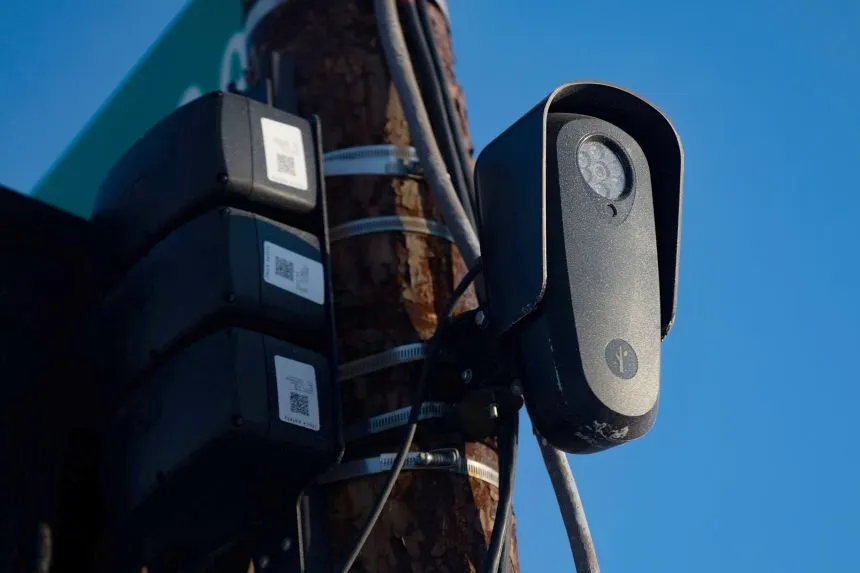
Flock Safety Surveillance and Privacy Concerns
One of the biggest concerns surrounding Flock Safety is the possibility that surveillance data could be accessed for purposes unrelated to legitimate investigations.
A Washington Post investigation identified dozens of cases involving police officers accused of improperly using Flock’s surveillance network, including allegations involving officers using the technology to monitor former or current romantic partners.
The cases have intensified concerns among privacy advocates that large-scale surveillance systems can create opportunities for abuse when strong oversight mechanisms are not in place.
Langley acknowledged the seriousness of those incidents during an interview with CBS News, saying he was deeply troubled by the experience of one alleged victim.
At the same time, the Flock CEO argued that the company’s technology did not create the underlying problem of police misconduct.
“I don’t think that Flock created police abuse,” Langley said. “I think we’re the first company to ever shine a light on it and build the tools to find it.”
The distinction highlights one of the central arguments surrounding surveillance technology: whether technology companies should primarily be responsible for preventing misuse or whether police departments and government regulators should establish stricter controls.
Flock Has Changed Its Data Policies
Flock has already introduced several changes in response to criticism.
The company reduced the default retention period for some surveillance data from 30 days to seven days. It also introduced a requirement for users to enter a case code before accessing certain information.
However, privacy advocates have questioned how effective those changes will be because the restrictions can reportedly be overridden in certain circumstances.
One example is Flock’s Evidence Mode, which can allow data to be retained for longer periods when it is associated with an investigation.
The American Civil Liberties Union has argued that shorter default retention is a positive step but said the system needs stronger safeguards.
The organization has previously called for much shorter retention periods and questioned how Flock’s Evidence Mode could affect the company’s privacy commitments.
Political Pressure Is Growing
The debate over Flock is no longer limited to privacy organizations and technology critics.
Politicians from both sides of the political spectrum have begun raising concerns about automated surveillance and the collection of information through camera networks.
Democratic politicians have criticized the expansion of Flock cameras as a form of mass surveillance that could allow governments to monitor people’s movements without their direct knowledge.
Republican lawmakers have also raised concerns, particularly around government use of automated surveillance technologies.
Three House Republicans recently introduced legislation that would restrict federal government purchases of automated surveillance systems using technologies such as facial recognition, biometric identification and license plate recognition.
The legislation specifically references Flock Safety cameras.
The bipartisan nature of some of these concerns illustrates how surveillance technology has become a broader political issue rather than one confined to traditional privacy debates.

The Bigger Privacy Question
Flock’s controversy reflects a much larger question about how modern surveillance technology should be used.
Traditional police investigations often depended on officers physically observing a location or obtaining information through specific investigative procedures.
Automated license plate recognition changes that equation.
A network of cameras can potentially collect information about vehicles across large geographic areas without requiring an officer to be physically present. When those systems are connected across multiple jurisdictions, the amount of information available to investigators can become significantly larger.
That can be useful when searching for a vehicle connected to a serious crime. But critics argue that the same infrastructure can create a detailed record of people’s movements if access and retention aren’t tightly controlled.
The growing use of connected technology is also forcing organizations to rethink how sensitive information is protected and who should have access to it.
This is where Flock’s argument about balancing safety and privacy becomes particularly important.
The question isn’t necessarily whether communities should use technology to help solve crimes. Instead, policymakers must determine how much surveillance is appropriate, who can access the information, how long it should be retained and what happens when someone misuses it.
Flock Calls for More Regulation
Langley has indicated that Flock supports stronger consequences for people who illegally access or misuse surveillance data.
He has called for states to make unauthorized use of Flock data a criminal offense.
During his Fox News appearance, Langley also argued that the broader surveillance technology industry needs clearer rules and accountability.
“Today, it is too often that in Flock and in other technologies, there’s no regulation. There’s no accountability, and we think that’s wrong,” he said.
That position could become increasingly important as more cities and police departments deploy automated surveillance systems.
What Happens Next?
Flock Safety is likely to remain at the center of the debate over privacy and public safety as lawmakers, police departments and civil liberties organizations examine how automated surveillance should be regulated.
The company has already introduced changes to its data policies, but critics argue that meaningful privacy protections will depend on how those policies operate in practice.
For communities using Flock cameras, the bigger issue may ultimately be less about the cameras themselves and more about the rules surrounding them.
Clear limits on data retention, strict access controls, independent oversight and meaningful penalties for misuse could determine whether automated surveillance becomes a useful law-enforcement tool or another source of concern about privacy in an increasingly monitored society.
The debate over Flock Safety therefore represents a much broader challenge facing modern technology: how can governments use powerful surveillance tools to improve public safety without turning everyday movements into permanent records?
Sources: Washington Post, CBS News, Fox News, American Civil Liberties Union, and Axios.
This Future Tech Hub article is independently written and organized using publicly available information from the sources above.