
The NASA and IBM AI model is a new open-source artificial intelligence system designed to help researchers analyze the Moon and better understand its surface.
Called the NASA-IBM Lunar Foundation Model, the system is designed to process lunar imagery and scientific data and could help identify features such as craters and potential deposits of ice. The organizations are also releasing a large dataset that researchers can use to develop their own lunar AI models.
The project comes as NASA prepares for future Artemis missions and a new phase of lunar exploration in which scientists will increasingly rely on automated analysis of large volumes of data.
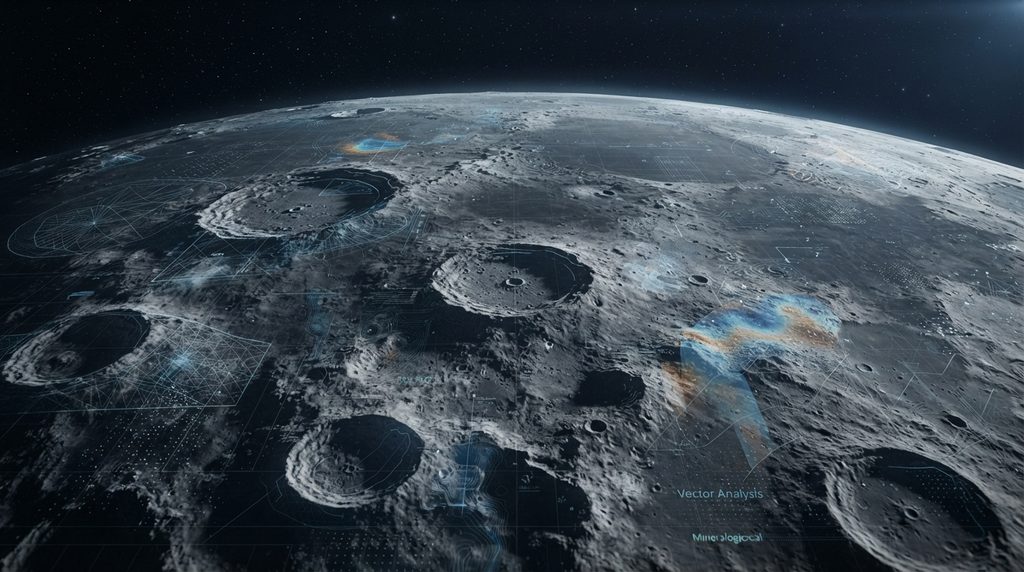
How the NASA and IBM AI Model Works
The NASA-IBM Lunar Foundation Model is an AI system trained specifically to understand information collected from the Moon.
Rather than being designed for a single task, the foundation model can be adapted for different types of lunar research. NASA and IBM say one of its promising applications is identifying regions on the lunar surface where water ice could potentially exist.
Finding lunar ice is particularly important because water could become a valuable resource for future missions. It could potentially provide drinking water for astronauts and, after processing, could also contribute to the production of oxygen and rocket propellant.
The model is being released as an open-source system through Hugging Face, giving researchers and developers access to the technology for further experimentation.
Much of modern lunar surface research relies on data collected by missions such as NASA’s Lunar Reconnaissance Orbiter.
AI showed strong results in lunar surface analysis
NASA and IBM tested the model against existing computer vision technology to determine how accurately it could interpret lunar imagery.
In one test, researchers compared its predictions about potential ice locations with a scientific map created using an established workflow that combines terrain, temperature, and other environmental information.
The NASA-IBM model reportedly reduced errors by 23 percent compared with SwinV2-B, a vision model developed by Microsoft that is commonly used as a benchmark for image-analysis tasks.
The researchers also tested how well the model could recognize and classify lunar craters.
In that evaluation, the NASA-IBM model performed 19 percent better than SwinV2-B while requiring only half as much training data.
Those results suggest that specialized AI models could become increasingly useful as scientists process the enormous amount of imagery generated by lunar missions.

The Moon presents unusual challenges for AI
Training an AI system to analyze the Moon is not as straightforward as training one to interpret images of Earth.
One major problem is lighting.
On Earth, our atmosphere scatters sunlight, which produces softer shadows and allows cameras to capture information in areas that are not directly illuminated. The Moon has no substantial atmosphere, meaning its shadows can be extremely dark and sharply defined.
As the Sun moves across the lunar sky, the same crater can therefore look dramatically different depending on when an image was captured.
For an AI model, that creates a difficult visual problem. A feature that appears obvious in one image may look completely different under another lighting condition.
NASA and IBM had to account for those differences while developing the model.
Traditional AI training methods did not work well
The research team also encountered difficulties with conventional computer vision training techniques.
One common approach involves hiding a large portion of an image and asking an AI model to reconstruct the missing information based on patterns it learned during training.
That method can work well with many types of imagery, but lunar terrain presents a problem because craters and other geological formations can look remarkably similar from orbit.
If a model sees only a small section of a crater, it may incorrectly assume that the missing portion resembles another crater it encountered during training.
To address the problem, the researchers changed how they divided their lunar data.
Instead of randomly separating images into training and testing sets, they divided the Moon into geographical sections. Data from some sections was used to train the model, while separate sections were reserved for testing.
This approach helped researchers determine whether the AI could actually generalize what it learned to unfamiliar parts of the lunar surface.
The model was tested on a new lunar crater
The technology recently faced an unusual real-world test.
Following the reported crash of a SpaceX Falcon 9-related object on the Moon on August 5, researchers used an image of the impact area with the NASA-IBM model.
The AI correctly identified the newly created impact site as a crater, even though it overlapped closely with an existing crater.
That is significant because identifying newly formed geological features can be difficult when they appear alongside structures that already exist in lunar imagery.
The result provided researchers with an opportunity to see how the model performed on an event that was not simply part of a controlled laboratory benchmark.
NASA and IBM are releasing lunar research data
The project is also notable because the organizations are making a large dataset available to other researchers.
The dataset combines tens of thousands of images and scientific measurements collected by several lunar missions.
Among the sources are NASA’s Lunar Reconnaissance Orbiter (LRO) and Gravity Recovery and Interior Laboratory (GRAIL) missions, along with data from Japan’s Selenological and Engineering Explorer (SELENE) mission.
The system relies on machine learning to recognize patterns in lunar imagery and distinguish features such as craters across different lighting conditions.
Making this information available could help researchers develop new AI systems without having to assemble the same datasets from scratch.
It could also encourage experimentation beyond the original NASA-IBM model, potentially leading to specialized systems for geological mapping, crater detection, resource identification, and other forms of lunar research.
Further information about IBM’s work in artificial intelligence is available through IBM Research.
Why AI could become important for future Moon missions
Modern space missions generate enormous amounts of data.
Researchers cannot manually examine every image and measurement at the same speed as an AI system. Machine learning can help identify patterns, highlight unusual features, and prioritize information that deserves closer scientific investigation.
That could become increasingly important as lunar exploration expands.
Future missions are expected to collect increasingly detailed observations of the lunar surface, particularly around areas that could be important for long-term human exploration.
AI systems could help scientists process that information faster while allowing human researchers to concentrate on interpreting the most important findings.
The technology could also become useful beyond the Moon. Techniques developed to handle extreme lighting conditions, limited training data, and unfamiliar geological environments could potentially contribute to AI systems designed for other planetary bodies.
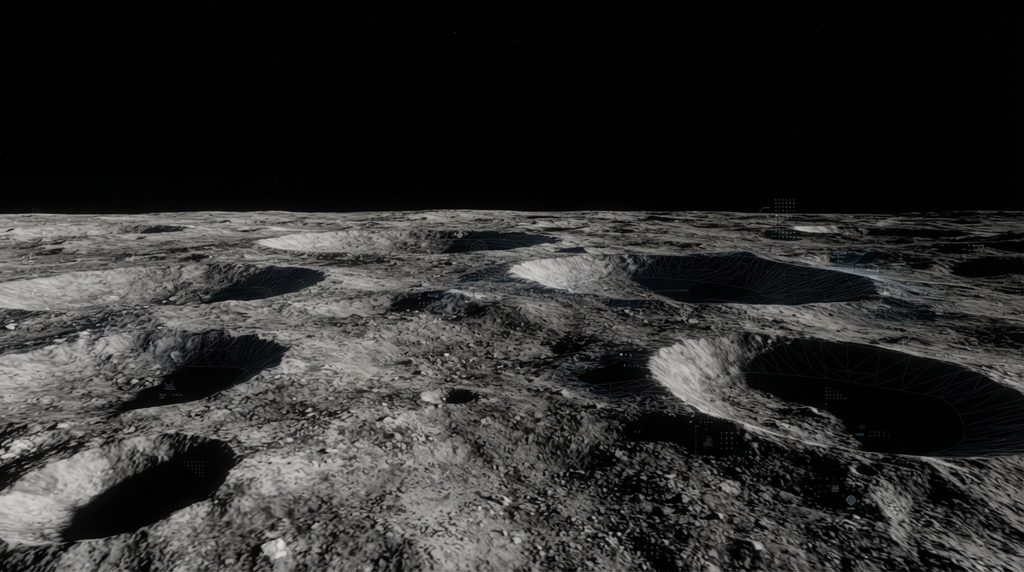
An open approach to lunar AI
The decision by NASA and IBM to release both the model and a substantial research dataset could be just as important as the model’s benchmark results.
Instead of keeping the technology exclusively within the project, an open approach allows universities, researchers, developers, and other organizations to experiment with the data and build new applications.
That could create a broader ecosystem of AI tools for planetary science.
As humanity prepares for a new era of lunar exploration, artificial intelligence may become an increasingly important part of how scientists understand worlds beyond Earth. The NASA-IBM Lunar Foundation Model is an early example of how machine learning could help turn massive amounts of lunar data into useful scientific knowledge.

Stay Ahead With Future Tech Hub
Technology moves fast. We keep you ahead with the latest AI, technology, cybersecurity, software, and gadget news.