
Software trends 2026 are being driven by artificial intelligence, automation, cloud computing, cybersecurity, and new ways of interacting with digital products. Software is no longer simply a tool that waits for users to click buttons and enter commands. Increasingly, applications can understand natural language, automate tasks, analyze information, and adapt to the way people work.
As these technologies continue to develop, software is becoming more intelligent and connected across computers, smartphones, businesses, and other devices.
Here are seven software trends that could have a major impact throughout 2026 and beyond.

1. AI Is Becoming a Standard Software Feature
Artificial intelligence is quickly becoming part of mainstream software.
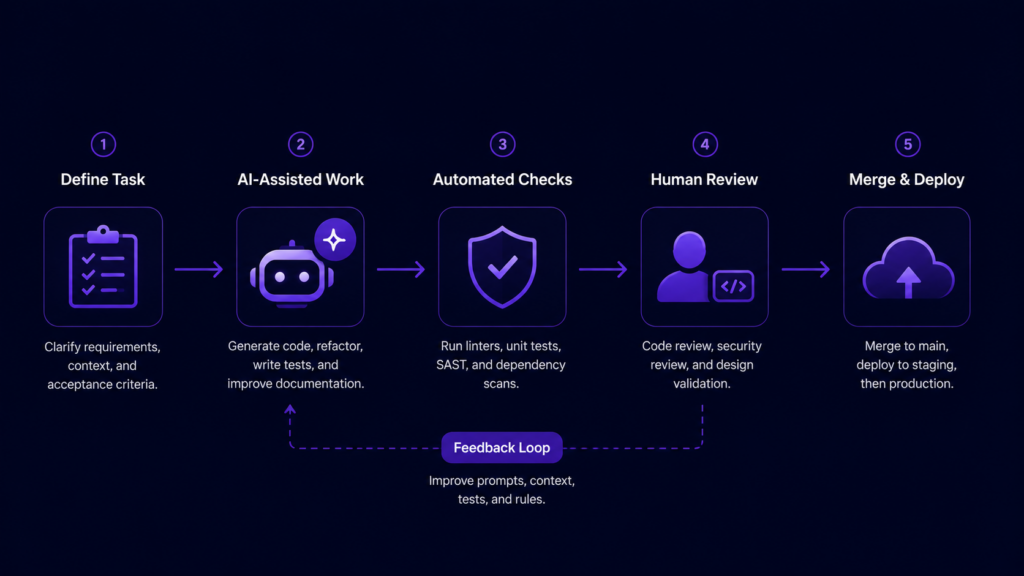
Instead of requiring users to open a separate AI application, many programs are adding AI directly into their existing features. Writing tools can help create and edit content, productivity applications can summarize information, and development platforms can assist programmers with code.
This integration could make software easier to use because people can describe what they want instead of manually completing every step.
For businesses, AI-powered software can also help automate repetitive processes and analyze large amounts of information.
The challenge will be making these features genuinely useful rather than simply adding AI because it is popular.
2. AI Agents Could Automate More Complex Tasks
AI assistants can already answer questions and generate content, but software is increasingly moving toward AI agents that can complete multiple steps toward a goal.
An AI agent could potentially research information, organize data, create a report, and prepare the result for a human to review.
This could have a major impact on business software. Tasks that previously required employees to move information between several applications could eventually be partially automated.
However, autonomous software also creates new security risks. Organizations will need to carefully control what agents can access and what actions they are allowed to perform.
3. Cloud Software Will Continue to Evolve
Cloud computing has already changed how people use software.
Instead of installing every application directly on a computer, users can access many services through web browsers and connected applications.
Cloud platforms allow companies to scale their infrastructure, collaborate remotely, store data, and access applications from different devices.
The next stage will likely involve more intelligent cloud services that combine AI, automation, analytics, and collaboration tools.
At the same time, companies will continue looking for ways to control cloud costs, improve performance, and protect sensitive information.
4. Software Security Will Become More Important
As software becomes more connected, cybersecurity becomes an even bigger priority.
Applications can contain sensitive information, communicate with external services, and connect to cloud infrastructure. A vulnerability in one component can potentially create problems across an entire system.
Developers are therefore placing more emphasis on secure development practices, automated security testing, identity management, and software supply-chain security.
AI is also becoming part of the security process. Security teams can use intelligent tools to analyze large amounts of activity and identify unusual behavior more quickly.
However, attackers can use AI as well, making secure software development more important than ever.
5. Low-Code and No-Code Development Will Grow
Building software traditionally required programming knowledge and specialized development teams.
Low-code and no-code platforms are changing that by allowing users to create applications with visual interfaces and pre-built components.
Businesses can use these platforms to create internal tools, automate workflows, manage data, and build simple applications without developing everything from scratch.
AI could make these platforms even more accessible. Users may increasingly be able to describe an application they need in natural language and have software generate parts of the solution automatically.
Professional developers will still be essential for complex systems, but low-code tools can reduce the amount of repetitive development work.
6. Software Will Become More Connected
Modern businesses rarely use a single application.
Companies may rely on customer relationship management systems, communication platforms, accounting software, cloud storage, analytics tools, and many other services.
Because of this, integration is becoming increasingly important.
Modern software is being designed to communicate through APIs and other integration technologies. This allows information to move between applications and helps organizations create automated workflows.
For users, better integration can mean less repetitive data entry and fewer applications that need to be managed manually.
The result could be software ecosystems where different tools work together almost like a single platform.
7. Software Will Become More Natural to Use
Another important software trend is the move toward natural interaction.
For decades, users have had to learn menus, settings, buttons, and complicated workflows. AI is beginning to change that.
Instead of searching through multiple menus, users can increasingly describe what they want in everyday language.
For example, someone could ask software to summarize a document, organize a spreadsheet, create a presentation, or find specific information.
Voice interfaces and AI assistants could make this approach even more common across computers, smartphones, and other devices.
The goal isn’t to remove traditional interfaces completely. Instead, software could give users multiple ways to accomplish the same task.
What Software Trends 2026 Mean for Users
The biggest change is that software is becoming less passive.
Traditional applications generally waited for users to tell them what to do. Modern software can increasingly suggest actions, automate processes, analyze information, and assist with decision-making.
This can save time, but it also means users need to understand how these systems handle their information.
Privacy, security, accuracy, and transparency will become increasingly important as software gains access to more personal and business data.
Users should also avoid assuming that AI-generated results are always correct. Important information should still be reviewed before decisions are made based on it.

The Future of Software
Software trends 2026 show that the industry is moving toward applications that are more intelligent, automated, connected, and easier to interact with.
Artificial intelligence will likely remain one of the biggest forces behind this transformation, but other technologies will play important roles as well.
Cloud computing, cybersecurity, low-code development, APIs, automation, and natural-language interfaces are all contributing to a broader change in how software is created and used.
The most successful software will not necessarily be the software with the most features. Products that are reliable, secure, easy to use, and genuinely helpful are more likely to stand out.
As these trends continue to develop, software could become less about learning complicated tools and more about simply telling technology what you want to accomplish.
For users, that could make computing more accessible. For businesses, it could create new opportunities to automate work and operate more efficiently.
The future of software is becoming more intelligent—and 2026 could be an important step toward that future.
Recent industry analysis also points to AI-assisted development, cloud-native applications, automation, cybersecurity, and low-code development as important areas shaping modern software. These developments suggest that software is moving toward faster development cycles and more intelligent tools, while businesses continue to focus on security, scalability, and efficiency.