
AI race is entering a new era as companies and countries compete to build more capable artificial intelligence systems. The first major wave of generative AI introduced millions of people to systems that could write, summarize, create images, answer questions, and generate computer code. Now the competition is moving beyond simple chatbots toward AI agents, autonomous systems, robotics, specialized chips, and increasingly powerful models.
The first major wave of generative AI introduced millions of people to systems that could write, summarize, create images, answer questions, and generate computer code. Now the competition is moving beyond simply building chatbots that produce better responses.
The next stage is about creating AI systems that can reason through complex problems, use tools, perform multiple steps independently, interact with the physical world, and become deeply integrated into businesses and everyday technology.
That shift is changing what companies are competing for — and what the future of artificial intelligence could look like.

From Chatbots to More Capable AI Systems
Early generative AI products were largely built around a simple interaction: a person entered a prompt and the AI generated a response.
That model is still important, but increasingly capable systems are being designed to do much more.
Modern AI can work with text, images, audio, video, and software tools. Some systems can break complicated requests into smaller tasks, use external information, write and execute code, and continue working through a problem with less human intervention.
This development is helping drive interest in AI agents, which are designed to move beyond simply responding to users and can potentially perform tasks on their behalf.
Unlike a traditional chatbot that mainly responds to a user, an AI agent can be designed to take actions on the user’s behalf. That could mean researching information, interacting with software, analyzing data, managing workflows, or completing a sequence of tasks.
The difference may appear subtle, but it could become one of the most important changes in the AI industry.
The Competition Is No Longer Just About Bigger Models
For years, much of the AI race focused on building increasingly large and capable models.
Scale still matters, but the competition is becoming more complicated.
Companies are now competing across several layers of the AI ecosystem, including model performance, reasoning, inference speed, computing infrastructure, specialized processors, data, software tools, and real-world applications.
A smaller model that is cheaper and faster to operate can sometimes be more useful to a business than a much larger model that requires enormous computing resources.
This is creating pressure to make AI systems not only smarter, but also more efficient.
The result is an industry increasingly focused on the entire AI stack rather than a single model.
AI Agents Could Change How Software Works
One of the biggest developments in the new AI era could be the transformation of software itself.
Traditional software usually requires users to understand menus, applications, commands, and workflows. AI agents could provide another way of interacting with technology.
Instead of manually moving information between several applications, a user could describe a goal and allow an AI system to coordinate multiple steps.
For example, an AI agent could potentially analyze a spreadsheet, identify important changes, prepare a report, search for supporting information, and organize the results.
This does not mean every AI system can reliably perform these tasks today. Accuracy, security, permissions, and reliability remain significant challenges.
But the direction is clear: AI is increasingly moving from answering questions toward performing tasks.
AI Is Moving Into the Physical World
The AI race is also expanding beyond computers.
Companies are investing heavily in robotics and what is increasingly being called physical AI — systems that allow machines to understand and interact with the real world.
Humanoid robots are one visible example.
Training these machines requires enormous amounts of physical-world data. A robot needs to learn how objects behave, how people move, how environments change, and how different actions produce different results.
That creates a new demand for data that traditional internet-scale AI systems did not necessarily need.
The combination of advanced AI models, sensors, robotics, and increasingly powerful hardware could eventually bring artificial intelligence into factories, warehouses, transportation, healthcare, and other physical environments.
Specialized Chips Are Becoming a Strategic Advantage
None of this development happens without computing power.
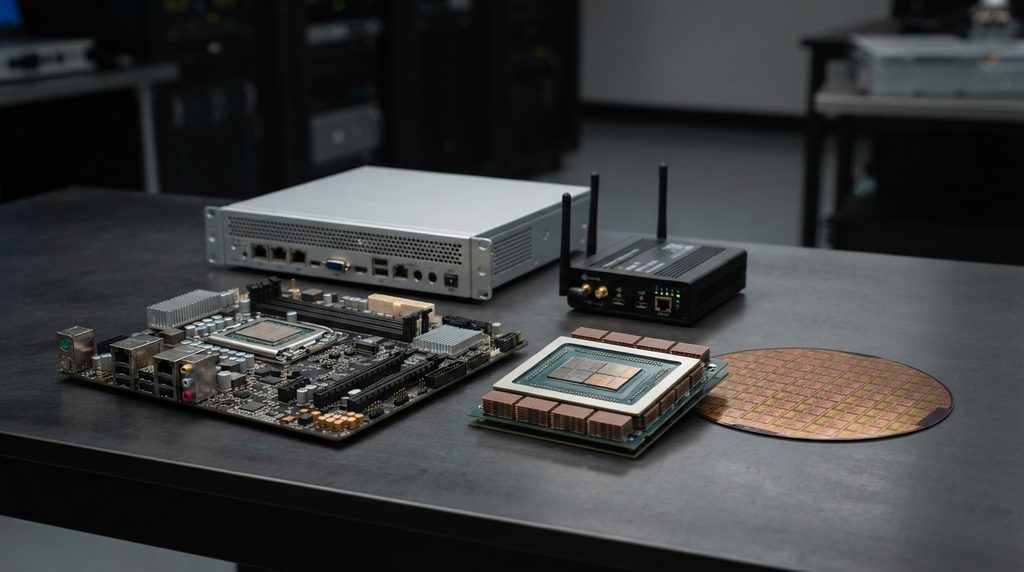
Training and operating advanced AI models requires enormous amounts of processing capacity. That has turned AI chips and semiconductor technology into strategic assets.
Graphics processing units and specialized AI accelerators are now central to the industry’s growth.
Companies are therefore competing not only to create better AI models, but also to secure access to the hardware required to run them.
This has consequences far beyond individual technology companies.
Governments are increasingly treating advanced semiconductors, manufacturing capacity, and computing infrastructure as matters of economic and national importance.
The AI race is therefore becoming partly a race for compute.
The Global AI Race Is Becoming More Competitive
Artificial intelligence is also becoming a geopolitical issue.
The United States and China remain central players in AI development, while Europe and other regions are attempting to strengthen their own technological capabilities.
Countries want access to advanced models and computing infrastructure, but they also want domestic AI industries that can compete globally.
This creates a complicated balance between cooperation and competition.
AI research has traditionally benefited from international collaboration and the movement of ideas between countries. At the same time, governments are increasingly concerned about technological dependence, national security, advanced chips, data, and strategic AI capabilities.
The result is a global competition that extends well beyond Silicon Valley.
AI Safety Is Becoming More Important
Greater AI capability also creates greater responsibility.
As AI systems become more autonomous, mistakes could potentially have consequences beyond an incorrect chatbot response.
An AI system connected to business software, financial systems, infrastructure, or other tools could cause much greater damage if it behaves incorrectly or is manipulated.
Organizations are also developing frameworks for managing these risks, including the NIST AI Risk Management Framework, which provides guidance for incorporating trustworthiness considerations into the design and use of AI systems.
Researchers are trying to understand how advanced systems behave, identify dangerous capabilities, improve safeguards, and reduce the possibility that AI systems will act in ways their developers did not intend.
The challenge is that safety mechanisms must develop alongside the technology itself.
Building increasingly capable AI without understanding its limitations could create risks that are difficult to reverse later.
The Business Opportunity Is Enormous
Despite the risks, companies are continuing to invest because the potential economic impact of AI is enormous.
AI can automate repetitive work, assist employees, improve software development, analyze large datasets, accelerate research, and create entirely new products.
Businesses are also discovering that AI does not have to replace an entire job to have a significant impact.
Automating a few time-consuming tasks can change how an employee spends an entire workday.
This is likely to make AI adoption increasingly practical across industries that previously had little connection to artificial intelligence.
The Next AI Winners May Not Be the Companies We Expect
The current AI industry is dominated by a relatively small number of major technology companies, but the next stage could create opportunities for many different players.
Model developers, chip manufacturers, cloud providers, robotics companies, data providers, cybersecurity firms, and specialized software companies can all benefit from the expansion of AI.
Some businesses may succeed by building the most advanced models.
Others may win by making AI cheaper, safer, easier to deploy, or more useful for a particular industry.
That means the AI race is unlikely to have a single winner.
Instead, it could produce an enormous ecosystem of companies competing across different layers of the technology.
What Comes Next?
The next phase of artificial intelligence could look very different from the chatbot boom that introduced generative AI to the mainstream.
AI agents may become more capable of completing tasks. Robotics could bring AI into the physical world. Specialized chips could make increasingly powerful systems more efficient. Businesses could integrate AI deeply into everyday workflows.
At the same time, governments will face difficult questions about regulation, national competitiveness, privacy, employment, security, and safety.
The most important competition may ultimately not be about which company creates the most impressive demonstration.
It may be about who can turn advanced AI into technology that is reliable, affordable, secure, and genuinely useful.
The AI race is entering a new era, and the next winners will likely be determined not simply by who builds the smartest model, but by who can successfully turn intelligence into dependable action.
Stay Ahead With Future Tech Hub
Technology moves fast. We keep you ahead with the latest AI, technology, cybersecurity, software, and gadget news.