
Artificial intelligence is no longer limited to large technology companies with dedicated AI teams. Small businesses can now use AI tools to automate repetitive work, create content, communicate with customers, analyze information, and improve everyday productivity.
The biggest advantage isn’t simply having access to AI. It’s choosing tools that solve real business problems without adding unnecessary complexity or expense.
From writing and research to automation and customer service, here are some of the best AI tools for small businesses and what they can actually be used for.
Source: TechRadar
Why Small Businesses Are Turning to AI
Small businesses often have to accomplish a lot with limited time and resources.
One person might be responsible for marketing, customer communication, administration, research, and social media at the same time.
AI can help reduce some of that workload.
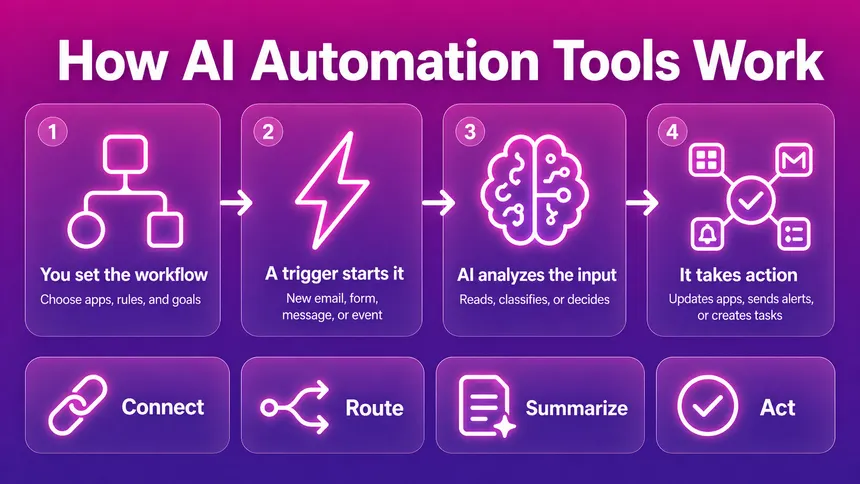
For example, an AI assistant can help draft an email in seconds, while an automation platform can connect different applications and handle repetitive tasks automatically.
The goal shouldn’t be to replace every human task with AI. Instead, businesses can use AI to handle repetitive work and give employees more time to focus on customers, strategy, and decisions that require human judgment.
ChatGPT for Writing, Research and Business Tasks
ChatGPT is one of the most versatile AI tools available to small businesses.
It can help with a wide range of everyday tasks, including:
- Writing and improving emails
- Creating marketing ideas
- Drafting social media content
- Summarizing documents
- Brainstorming business ideas
- Research assistance
- Creating customer support responses
- Analyzing information
- Writing and explaining code
- Creating business documents
Small businesses don’t necessarily need a separate AI tool for every individual task. A general-purpose AI assistant can cover many use cases from a single platform.
However, businesses should still review AI-generated information before publishing it or using it for important decisions.
Google Gemini for Research and Productivity
Google Gemini can be useful for businesses that already rely heavily on Google’s ecosystem.
It can assist with writing, brainstorming, research, summarization, and other productivity tasks.
For teams working with Google Workspace, AI features can also become particularly useful when working with documents, emails, spreadsheets, and other business information, depending on the available plan and features.
One advantage of using an AI assistant that fits into an existing software ecosystem is that employees don’t necessarily need to change the way they work completely.
Microsoft Copilot for Microsoft 365 Users
Businesses that rely on Microsoft products may benefit from Microsoft Copilot.
Copilot can assist with tasks across Microsoft’s ecosystem, depending on the specific product and subscription.
Potential business uses include:
- Drafting and summarizing emails
- Creating documents
- Summarizing meetings
- Working with spreadsheets
- Preparing presentations
- Finding information
- Generating ideas
For companies already using Microsoft 365, integrating AI into familiar applications can make adoption easier.
Canva AI for Marketing and Design
Not every small business has access to a professional designer.
Canva provides design tools that can help businesses create social media graphics, presentations, advertisements, flyers, promotional materials, and other visual content.
Its AI-powered features can assist with generating and editing visual content and can speed up parts of the design process.
This can be particularly useful for small businesses that need to produce marketing materials regularly but don’t want every design task to require specialized software.
AI can help with the initial creation, but businesses should still review the final design to make sure branding, spelling, product information, and messaging are correct.

Grammarly for Business Communication
Clear communication matters when dealing with customers, suppliers, and business partners.
Grammarly uses AI-powered features to help improve writing, grammar, clarity, tone, and other aspects of communication.
Small businesses can use it when preparing:
- Emails
- Website copy
- Marketing materials
- Customer responses
- Reports
- Internal documents
It can be particularly useful for businesses that communicate with international customers or teams and want an additional layer of writing assistance.
Zapier for AI-Powered Automation
One of the biggest opportunities for small businesses isn’t simply generating text or images. It’s automation.
Zapier connects different applications and can automate repetitive workflows.
For example, a business could create a workflow that:
- Receives a new form submission.
- Adds the customer information to a system.
- Sends a notification to a team member.
- Creates a task.
- Sends an automated follow-up email.
AI features can add another layer to these workflows by helping classify information, summarize content, or generate responses.
This can save employees from repeatedly moving information between different applications.

n8n for More Flexible Automation
Businesses looking for greater control over their automations may also want to consider n8n.
n8n is a workflow automation platform that can connect applications, APIs, databases, AI models, and other services.
It can be useful for businesses that want to build more customized workflows rather than relying entirely on pre-built automation templates.
For example, an AI-powered workflow could receive incoming information, process it with an AI model, categorize the result, and then send it to another application automatically.
The downside is that n8n can require more technical knowledge than simpler automation platforms.
For businesses with someone comfortable with technology, however, that flexibility can be valuable.
Notion AI for Organization and Knowledge Management
Small businesses generate a lot of information.
Meeting notes, project details, procedures, ideas, customer information, and internal documentation can quickly become difficult to organize.
Notion AI can help teams work with information stored in their Notion workspace.
Depending on the available features and plan, businesses can use AI to summarize information, generate content, organize ideas, and assist with workspace tasks.
This can be particularly useful for teams that want to keep their internal knowledge in one centralized location.
AI Customer Support Tools
Customer support is another area where AI can help small businesses.
AI-powered customer service tools can assist with answering common questions, organizing support requests, and providing information outside normal business hours.
For example, a company might use an AI chatbot to answer basic questions about:
- Opening hours
- Shipping
- Returns
- Pricing
- Product availability
- Frequently asked questions
However, businesses should make sure customers can reach a human when an issue is too complicated for an automated system.
AI should improve customer service rather than make customers feel like they are trapped in an automated system.
AI Meeting and Transcription Tools
Meetings can generate a lot of information that is easy to forget.
AI meeting tools can transcribe conversations, summarize discussions, identify important points, and sometimes generate action items.
This can save employees from manually taking notes throughout every meeting.
For small teams, the time savings can add up quickly, particularly when meetings happen frequently.
Businesses should still consider privacy and consent requirements before recording or transcribing meetings, especially when sensitive information is involved.
How to Choose the Right AI Tool
The best AI tool isn’t necessarily the one with the most features.
Before choosing a tool, consider the actual problem you’re trying to solve.
Ask:
What task takes too much time?
If employees spend hours writing repetitive emails, an AI writing assistant may help.
If the problem is repetitive data entry, an automation platform may be more valuable.
If marketing is the bottleneck, an AI design or content tool could provide a better return.
Also consider:
- Price
- Ease of use
- Integration with existing software
- Data privacy
- Security
- Scalability
- Customer support
- AI output quality
A small business doesn’t need ten different AI subscriptions to benefit from artificial intelligence.
In many cases, starting with one or two tools that solve a specific problem is a better approach.
AI Security and Privacy Matter
Businesses should be careful about what information they provide to AI systems.
Sensitive customer information, passwords, financial information, confidential business documents, and other private data shouldn’t automatically be pasted into an AI service without understanding how that service handles the information.
Businesses should review the provider’s privacy policies, security controls, data retention practices, and available business plans.
AI can improve productivity, but introducing another online service also introduces another security consideration.
For businesses concerned about AI security, it’s worth establishing clear internal rules about what employees can and cannot enter into AI tools.
Should Every Small Business Use AI?
Not necessarily.
AI is useful when it solves a real problem.
Buying an AI subscription simply because other businesses are using AI isn’t a strategy.
A better approach is to identify repetitive or time-consuming processes and determine whether AI can improve them.
Start small. Test one workflow, measure the result, and expand from there.
If an AI tool saves employees several hours every week without creating additional problems, it may be worth keeping.
If it produces unreliable results or requires more time to manage than the original task, it may not be the right solution.
Final Thoughts
The best AI tools for small businesses are the ones that provide practical value rather than simply having impressive features.
Tools such as ChatGPT, Google Gemini, Microsoft Copilot, Canva, Grammarly, Zapier, n8n, and Notion AI can help businesses with everything from writing and design to automation, organization, and customer communication.
The key is to start with a specific business problem and choose the technology that addresses it.
AI isn’t a replacement for good business processes. Used correctly, it can become another tool that helps small teams save time, reduce repetitive work, and focus on what matters most.
Stay Ahead With Future Tech Hub
Technology moves fast. We keep you ahead with the latest AI, technology, cybersecurity, software, and gadget news.