
Artificial intelligence is becoming an important part of modern cybersecurity. As businesses move more of their operations online, security teams are dealing with increasing amounts of data, devices, applications, and potential threats.
Traditional cybersecurity tools remain important, but they can struggle to keep up with the speed and complexity of modern attacks. AI can help security teams analyze information faster, identify unusual behavior, and respond to potential threats before they cause significant damage.
At the same time, cybercriminals are also using AI to improve their attacks. This has created a new security environment where artificial intelligence is being used on both sides.

Faster Threat Detection
One of the biggest benefits of AI in cybersecurity is faster threat detection.
Security systems can generate thousands of alerts, and security professionals cannot always investigate every alert immediately. AI can help analyze these events and prioritize the ones that appear most suspicious.
For example, an AI-powered security system could identify unusual login activity, unexpected data transfers, or suspicious connections between devices.
By identifying potentially dangerous activity earlier, organizations can investigate incidents before they become larger security problems.
As AI systems become more advanced, they are moving beyond simply generating responses and can increasingly perform tasks, make decisions, and interact with other tools. AI agents are a good example of this shift, combining AI reasoning with the ability to take actions toward a specific goal. If you want to understand how these systems work and how they differ from traditional AI assistants, read our guide: What Is an AI Agent? A Simple Guide to How AI Agents Work.
Detecting Unusual User Behavior
AI can also be used to understand normal user behavior and identify activities that don’t fit established patterns.
Consider an employee who normally accesses company files during working hours from a familiar device. If the same account suddenly attempts to access sensitive information from an unfamiliar location or device, an AI-powered system may flag the activity.
This type of behavioral analysis can help detect compromised accounts and insider threats.
The technology doesn’t automatically mean that unusual behavior is malicious. Instead, it gives security teams another signal that something may require investigation.
AI and Malware Detection
Malware is another area where AI can provide valuable assistance.
Traditional antivirus software often relies on known signatures to identify malicious files. While signature-based detection remains useful, attackers can modify malware to avoid traditional detection methods.
AI-powered security systems can analyze characteristics and behavior to identify potentially malicious files and applications.
For example, a security system could monitor what a program attempts to do after it starts running. If the application begins modifying system files, communicating with suspicious servers, or attempting to access sensitive information, the activity could trigger an alert.
This behavioral approach can provide another layer of protection against evolving malware.

Automated Incident Response
AI can also help organizations respond to threats more quickly.
When a serious security event occurs, every second can matter. Automated security systems can perform certain actions without waiting for a security professional to manually respond.
Depending on the system and its configuration, automated responses could include:
- Blocking suspicious network connections
- Isolating an infected device
- Disabling a compromised account
- Blocking malicious files
- Alerting security teams
- Collecting information about an incident
Automation can reduce response times and allow security professionals to concentrate on more complex investigations.
However, organizations should carefully control automated responses. An overly aggressive system could accidentally block legitimate users or applications.
AI Is Making Phishing More Convincing
AI is also creating new challenges for cybersecurity.
Phishing has traditionally relied on convincing users to click malicious links or provide sensitive information. AI can make these attacks more convincing by helping attackers produce realistic messages with better grammar and more personalized content.
Attackers can potentially use AI to create messages that appear to come from a company, colleague, customer, or other trusted source.
This means employees can no longer rely only on obvious spelling mistakes or awkward wording to identify phishing.
Security awareness, multi-factor authentication, email security, and careful verification remain important defenses.
AI Can Help Attackers Develop Malware
Cybercriminals can also use AI to assist with technical tasks.
Generative AI can potentially help attackers research systems, write or modify code, automate repetitive tasks, and develop more convincing social engineering campaigns.
This doesn’t mean AI automatically creates sophisticated cyberattacks. Attackers still require knowledge, infrastructure, and access to their targets.
However, AI can lower the amount of time required for certain activities and potentially make some attacks easier to scale.
AI-Powered Security for Businesses
AI can be especially valuable for small and medium-sized businesses that may not have large security teams.
Security platforms can use AI to continuously monitor systems and prioritize potential threats.
This can help businesses make better use of limited cybersecurity resources.
Instead of a security professional manually examining every event, AI can help identify which events are more likely to require attention.
However, businesses should not treat AI as a replacement for basic cybersecurity practices.
Strong passwords, multi-factor authentication, software updates, secure backups, access controls, employee training, and endpoint protection remain essential.
AI and Cloud Security
As more businesses move applications and data to cloud platforms, monitoring cloud environments has become increasingly important.
Cloud systems can contain large amounts of information and involve many users, devices, applications, and permissions.
AI can help analyze activity across these environments and identify unusual access patterns.
For example, an AI-powered security system could detect when an account suddenly begins accessing a large amount of data or when permissions are being used in an unusual way.
This can help organizations identify potential account compromises and misconfigured systems.
The Human Factor Still Matters
Despite the advantages of AI, cybersecurity cannot simply be handed over to automated systems.
AI systems can make mistakes. They can generate false positives, misunderstand context, or fail to recognize a sophisticated attack.
Human security professionals are still needed to investigate incidents, evaluate risks, develop security policies, and make important decisions.
The strongest approach is usually a combination of AI-powered security tools and human expertise.
AI can process information quickly, while humans can provide judgment and context.
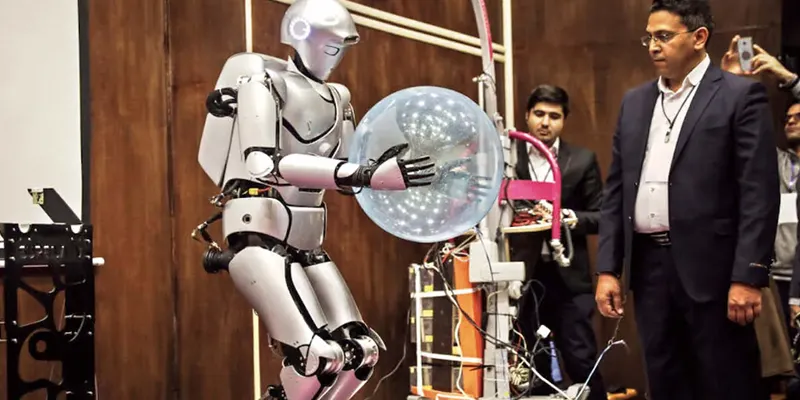
Source of the image: Built In
AI Can Also Create New Security Risks
Organizations adopting AI need to consider security risks associated with the technology itself.
AI systems may have access to sensitive business information, customer data, internal documents, or other valuable resources.
If these systems are poorly configured, attackers could potentially exploit them or gain access to information they shouldn’t have.
Businesses should therefore consider:
- Who can access AI systems
- What information employees can provide to AI tools
- How data is stored and processed
- Which third-party services are connected
- How AI systems are monitored
- What happens if an AI account is compromised
AI security should become part of an organization’s broader cybersecurity strategy rather than being treated as a separate issue.
Why AI Won’t Replace Cybersecurity Professionals
It can be tempting to think that AI will eventually handle cybersecurity without human involvement.
In reality, cybersecurity is too complex for that approach.
Security decisions often require understanding business operations, legal requirements, potential consequences, and the context surrounding an incident.
AI can identify patterns and provide recommendations, but humans still need to determine what action should be taken.
The role of cybersecurity professionals may change as AI becomes more capable, but their expertise will remain important.
Security teams will increasingly need to understand both traditional cybersecurity and AI technologies.
What Businesses Should Do
Businesses don’t need to completely rebuild their security infrastructure to benefit from AI.
A practical approach is to start by identifying areas where security teams spend significant amounts of time on repetitive work.
AI can then be introduced where it provides a clear benefit.
Businesses should also establish clear policies for the use of AI, particularly when employees are working with sensitive information.
AI tools should be evaluated based on security, privacy, reliability, integration capabilities, and the specific needs of the organization.
As businesses increasingly adopt AI-powered systems, traditional security strategies also need to evolve. Microsoft is expanding its Zero Trust approach to address the growing security risks associated with AI agents, automated systems, and modern cloud environments. This approach emphasizes continuously verifying users, devices, and access rather than automatically trusting anything inside a network. For a deeper look at how organizations are adapting their security strategies, read our article on Microsoft Expands Zero Trust Strategy to Secure the AI Era
Most importantly, AI should complement existing cybersecurity controls rather than replace them.
The Future of AI and Cybersecurity
The relationship between AI and cybersecurity will continue to evolve.
Security teams will likely use AI more extensively for monitoring, threat detection, incident investigation, vulnerability management, and automated response.
At the same time, attackers will continue experimenting with AI to improve phishing, malware, social engineering, and other techniques.
This means cybersecurity will become an ongoing competition between defensive and offensive uses of artificial intelligence.
Organizations that understand both the opportunities and risks of AI will be better prepared to adapt.
My Final Thoughts
AI is changing cybersecurity by helping organizations detect threats faster, analyze large amounts of information, automate certain responses, and identify suspicious behavior.
But AI is not a magic solution.
Cybercriminals are also using artificial intelligence to make their attacks more convincing and potentially more scalable. Businesses therefore need to approach AI as another layer of their security strategy rather than a replacement for fundamental protections.
The future of cybersecurity will likely depend on a combination of artificial intelligence, strong security practices, and human expertise.
For businesses and individuals, understanding how AI is changing cybersecurity is becoming increasingly important as both the technology and the threats surrounding it continue to develop.
Stay Ahead With Future Tech Hub
Technology moves fast. We keep you ahead with the latest AI, technology, cybersecurity, software, and gadget news.