
Chrome session hijacking is becoming a growing concern as security researchers demonstrate new ways attackers can access authenticated browser sessions on compromised Windows computers.
The technique uses the Chrome DevTools Protocol (CDP) inside an already-running browser process. According to researchers at SpecterOps, an attacker who already has code execution on a Windows computer could use the technique to interact with the browser’s existing authenticated state.
Importantly, this is not a remotely exploitable Chrome or Edge vulnerability. The attacker must already have significant access to the Windows computer before the technique can be used.
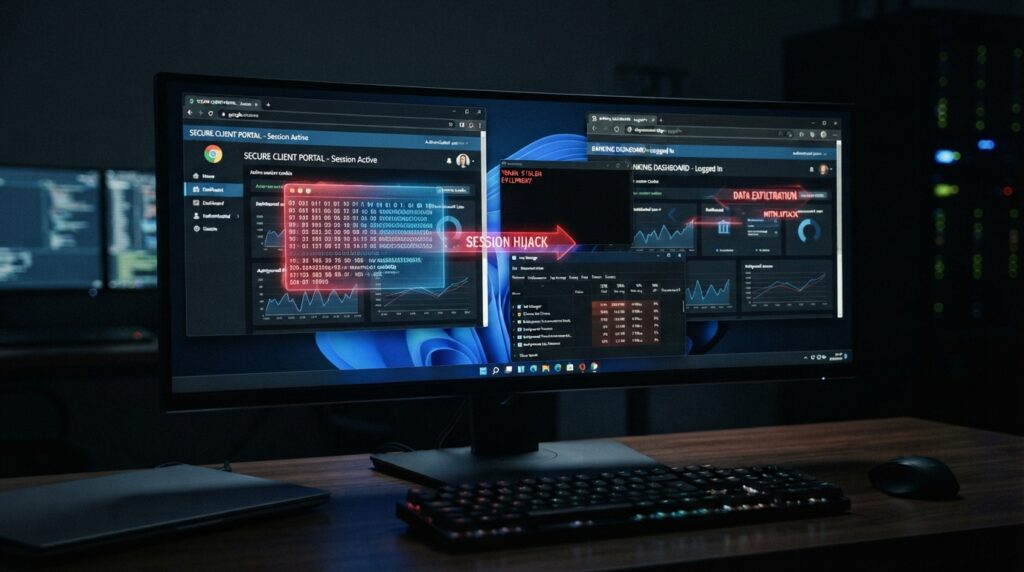
Chrome Session Hijacking Through the DevTools Protocol
The research from SpecterOps focuses on activating the Chrome DevTools Protocol inside a running Chrome or Microsoft Edge process.
CDP is a legitimate browser technology that allows developers and other tools to interact with Chromium-based browsers for tasks such as debugging, automation and testing.
The researchers demonstrated a technique that can activate the debugging interface from inside an existing browser process. This can potentially give an attacker access to parts of the browser’s existing environment.
According to SpecterOps, the technique can be used with both Chrome and Edge on Windows systems.
Why Chrome Session Hijacking Matters
Browser sessions are an important part of modern web applications.
After a user logs into a website, the browser can maintain that authenticated state through cookies and other session information. If an attacker gains access to that active browser environment, they may be able to interact with websites as the already-authenticated user.
The research describes capabilities that can include accessing browser cookies and other browser data, as well as interacting with authenticated browser sessions.
Potentially accessible information can include browsing history, bookmarks, installed extensions and other browser-related data, depending on the circumstances.
Google Has Already Changed Remote Debugging in Chrome
Google has previously taken steps to make browser-based cookie theft more difficult.
Beginning with Chrome 136, Google changed how Chrome handles certain remote debugging options when they target the browser’s default data directory.
The changes followed an increase in attacks using Chrome’s remote debugging functionality to extract cookies.
Google also introduced App-Bound Encryption, which is designed to make it more difficult for attackers to directly access sensitive browser data.
However, the SpecterOps technique takes a different approach by activating the debugging capability from inside an existing browser process.

Device-Bound Session Credentials Add Protection
Google has also introduced Device Bound Session Credentials (DBSC) for Chrome.
DBSC is designed to bind session credentials to a device using hardware-backed cryptographic keys. The technology aims to make stolen session credentials harder to transfer and reuse on another device.
However, SpecterOps’ research highlights a different scenario.
Instead of simply stealing a cookie and attempting to use it somewhere else, an attacker who already controls the compromised computer could potentially interact with the browser while it is still running and authenticated.
This makes endpoint security an important part of protecting browser-based accounts.
How Organizations Can Detect Suspicious Activity
SpecterOps says defenders can look for suspicious activity involving browser processes such as chrome.exe and msedge.exe.
Microsoft Sysmon provides security telemetry that can help organizations investigate process activity. In particular, Event ID 8 records remote thread creation, while Event ID 10 records process access.
These events can sometimes indicate process injection or other suspicious activity.
However, security teams should not automatically treat every Event ID 8 or Event ID 10 event as malicious because legitimate software can also generate these events.
Organizations should instead combine this information with other endpoint and behavioral indicators.
Browser Updates Still Matter
The publicly available research tools use browser-version-specific signatures.
SpecterOps listed specific Chrome and Edge versions as tested, meaning compatibility can change as browsers receive updates.
Keeping Chrome, Edge and Windows updated therefore remains an important security measure.
Browser updates can change internal components and potentially prevent techniques that depend on specific browser versions from working as originally demonstrated.
What Windows Users Should Know
For everyday users, this research does not mean that someone can remotely hijack a Chrome or Edge session simply by knowing the technique.
An attacker must first gain code execution and sufficient access to the Windows computer.
Users should therefore continue following basic security practices:
- Keep Windows and browsers updated.
- Avoid downloading software from untrusted websites.
- Be careful with unexpected email attachments and links.
- Use reputable endpoint security software.
- Enable multi-factor authentication whenever possible.
- Monitor accounts for unusual activity.
- Avoid using administrator accounts for everyday tasks when possible.
Organizations should also monitor unusual activity involving browser processes and investigate suspicious process-injection behavior.

The Bigger Security Lesson
The research highlights how valuable browser sessions have become to attackers.
Modern browsers can contain authenticated sessions for email, cloud applications, business platforms and other important services. They can also contain cookies, extensions, browsing data and other sensitive information.
As more businesses rely on cloud-based applications, protecting the browser and the endpoint behind it becomes increasingly important.
The SpecterOps research therefore reinforces a broader cybersecurity principle: protecting accounts is not enough if the computer running those accounts has already been compromised.
Sources
SpecterOps — Chrome DevTools Protocol Cookie Theft
https://specterops.io/blog/2026/08/13/chrome-devtools-protocol-cookie-theft/
The Hacker News — Chrome DevTools Technique Enables Authenticated Session Hijacking in Live Windows Browsers
https://thehackernews.com/2026/08/chrome-devtools-technique-enables.html
Google — Chrome Remote Debugging
https://developer.chrome.com/blog/remote-debugging-port
Microsoft — Sysmon Events
https://learn.microsoft.com/en-us/windows/security/operating-system-security/sysmon/sysmon-events