
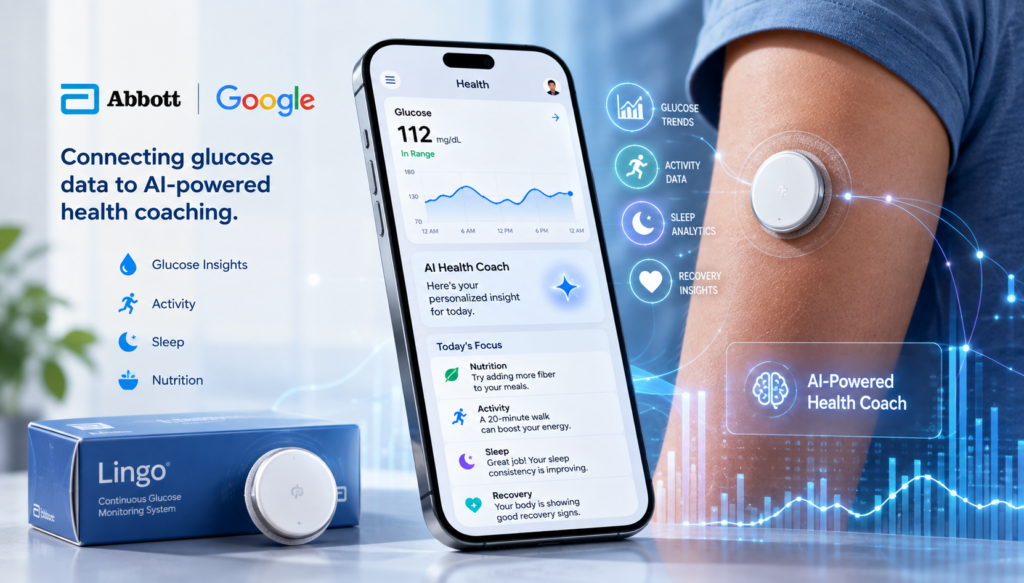
Google is expanding the amount of personal health information available to its AI-powered health tools through a new partnership with Abbott.
Under a multiyear agreement, glucose data from Abbott’s Lingo continuous glucose monitor will be integrated into the Google Health app. The move will allow users to view glucose trends alongside information such as physical activity, sleep, and other wellness data.
Google’s Gemini-powered Health Coach will then be able to use this information to provide more personalized recommendations related to areas such as nutrition, exercise, sleep, and recovery.
The integration is expected to begin rolling out in the Google Health app later this year.
Google Health Coach Gets Access to Glucose Data
Google Health Coach is designed to analyze personal health information and provide AI-generated guidance based on the data available to it.
The upcoming Abbott integration will add continuous glucose monitoring data to that information.
Lingo is an over-the-counter continuous glucose monitoring system intended for adults aged 18 and older who do not use insulin. The wearable continuously tracks glucose levels and allows users to see how factors such as food, exercise, and daily activities correspond with changes in glucose.
Once the integration becomes available, Lingo users will be able to see their glucose trends alongside other information stored in the Google Health app.
That could give Google’s AI coach a broader picture of a user’s daily habits.
For example, glucose trends could potentially be considered alongside activity and sleep information when Health Coach generates wellness recommendations. Google says the system will cover areas including nutrition, activity, sleep, and recovery.
However, Google makes an important distinction: Health Coach is not intended to be a medical tool.
The company warns that AI-generated responses can be inaccurate or incomplete and recommends that users verify information and consult healthcare professionals when appropriate.
What Is Abbott Lingo?
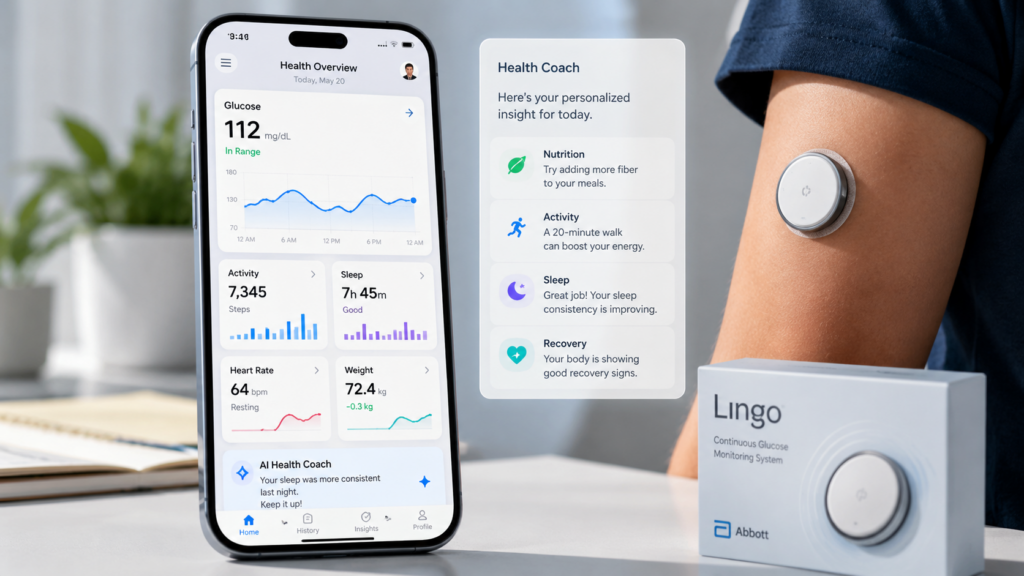
Abbott’s Lingo is a continuous glucose monitoring system designed for people who want to better understand how their daily habits relate to glucose levels.
The device uses a small sensor placed under the skin on the back of the upper arm. It measures glucose in interstitial fluid and sends readings to the Lingo smartphone application using Bluetooth Low Energy.
According to FDA documentation, the system can display real-time glucose measurements, trend information, and glucose graphs.
The sensor can be worn for up to 14 days.
Lingo is based on technology used in Abbott’s FreeStyle Libre platform, but the products have different intended uses.
While FreeStyle Libre 2 is designed for diabetes management, Lingo is intended for adults who do not use insulin and want to understand how glucose levels relate to factors such as nutrition, movement, and everyday activities.
Abbott began offering Lingo without a prescription in the United States in 2024, and the system is also available in the United Kingdom.
Importantly, FDA documentation states that users should not make medical decisions based on Lingo readings without consulting an appropriate healthcare professional.
Google Is Bringing More Health Data Into Gemini
The Abbott partnership is part of a broader effort by Google to make its Health platform more useful by bringing information from different sources together.
The Google Health app can already collect information from compatible wearables, third-party applications, and other health services.
Users can connect information involving areas such as:
- Physical activity
- Fitness
- Sleep
- Vital signs
- Medical records
- Other wellness information
Google previously expanded Health Coach’s capabilities by allowing users in the United States to sync medical records with the Google Health app.
That information can include laboratory results, vital signs, and medication information. Users can then share those records with Health Coach to ask questions or generate summaries.
The addition of continuous glucose data represents another step toward making Google’s AI systems capable of working with a wider range of personal health information.
The Privacy Question Around AI Health Coaching
As AI health assistants gain access to more personal information, privacy becomes an increasingly important part of the conversation.
Health data can be considerably more sensitive than information used by many other consumer AI applications. Combining medical records, sleep patterns, activity, medications, and continuous glucose measurements creates a detailed picture of an individual’s health and daily behavior.
Google says users have control over the information they save and can turn optional features on or off. The company also says users can export or delete their data.
Google states that Google Health data is not used for Google Ads.
Those controls will become increasingly important as health platforms connect more data sources to AI systems.
The goal is to make AI recommendations more useful without turning personal health information into something users feel they have lost control over.
Abbott and Google Plan a Real-World Metabolic Health Study
The partnership goes beyond integrating Lingo into the Google Health app.
Abbott and Google also plan to conduct a large real-world study focused on metabolic health.
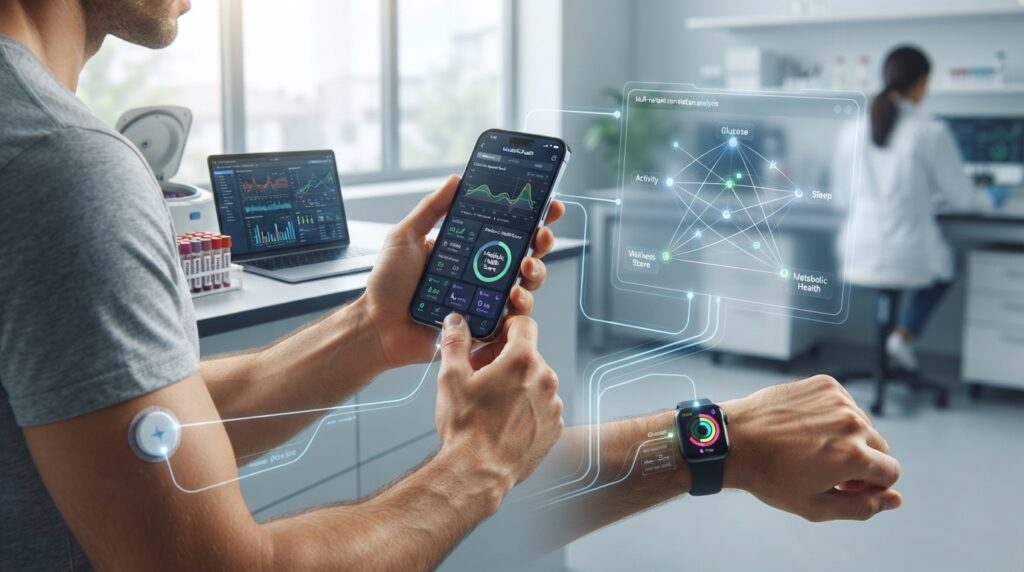
The study is expected to combine continuous glucose readings with information from wearables, laboratory testing, and surveys.
Researchers will examine relationships between factors such as physical activity, sleep, well-being, and metabolic health.
The companies say the resulting insights could be used to improve Google Health Coach and influence future Lingo features.
This could make the partnership more than just another connection between a wearable device and an AI assistant. The data collected through the study could help the companies better understand how different lifestyle factors interact with metabolic health.
Gemini Is Moving Further Into Healthcare
Google’s work with Abbott is part of a broader expansion of Gemini into health-related experiences.
Google is not limiting Gemini to answering general questions. The company is increasingly connecting its AI technology with specialized services and external applications.
Another recent development involves Zocdoc, which allows users in the United States to search for healthcare appointments and book providers through the Gemini app.
The connected service provides access to real-time appointment availability across a large network of healthcare providers.
Together, these developments show how Google is positioning Gemini as more than a traditional chatbot.
The long-term direction appears to be an AI assistant that can work with information from multiple parts of a user’s digital life, including health, fitness, appointments, and personal records.
What This Means for the Future of AI Health Assistants
The Abbott and Google partnership highlights an important direction for consumer AI: AI assistants are becoming more personalized as they gain access to more real-world data.
Instead of relying only on information entered into a chatbot, future AI systems could combine information from wearables, health applications, medical records, and other connected devices.
That could make AI-generated guidance more relevant to an individual’s circumstances.
At the same time, the technology comes with significant limitations.
Health information is highly sensitive, and AI systems can make mistakes. Users need to understand the difference between an AI-generated wellness recommendation and professional medical advice.
Google’s own warning about the possibility of inaccurate or incomplete responses reinforces that distinction.
For now, the Abbott integration represents another step toward a future where AI and wearable technology work together to provide increasingly personalized health insights.
As Google continues expanding Gemini across healthcare and other areas, the bigger question will be how effectively these systems can balance personalization, accuracy, privacy, and user control.
Source: Artificial Intelligence News
This Future Tech Hub article is independently written and organized using publicly available information from the sources above.